


Portable Countertop Cooking Equipment for Commercial Kitchens
Portable countertop cooking equipment allows flexible boiling, frying, grilling and deep-frying on a compact footprint. It is suitable as the main equipment in small businesses, for extra capacity and for changing commercial cooking stations. Find out which unit suits your kitchen in our buying guide »






Using portable countertop cooking equipment flexibly
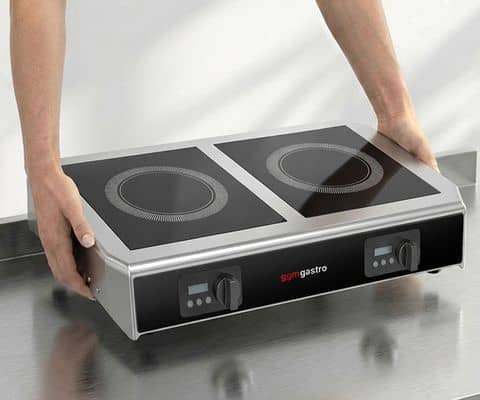
Portable countertop cooking appliances are compact commercial units that are operated on a suitable worktop. They take on clearly defined tasks such as boiling, frying, grilling or deep-frying without occupying a complete fixed cookline.
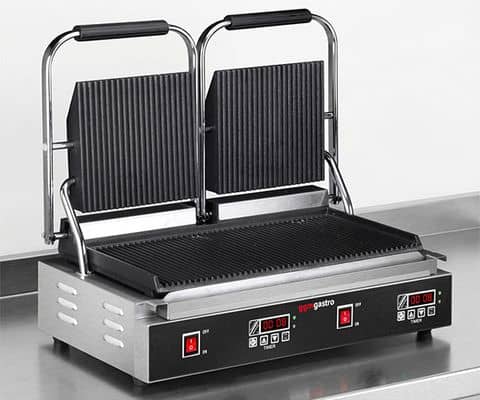
This makes them attractive for restaurants, takeaways, food trucks, hotels, caterers and contract caterers. A single unit can form a small production station, relieve an existing line during a rush or enable a changing menu. The category includes induction hobs, countertop boiling tops, fryers, griddles, pasta cookers, contact grills and salamanders, among others.
Matching equipment type and output to the real bottleneck
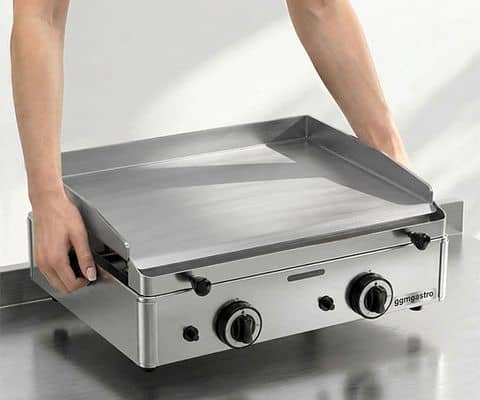
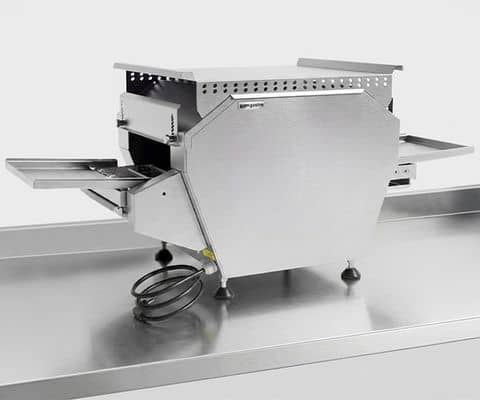
Selection starts with the work process. For cooking in portions or reheating, an induction hob is a good choice. Griddles create a continuous surface for meat, vegetables or breakfast items. Fryers handle defined batches, while contact grills and conveyor toasters are designed for repetitive grilling or toasting processes.
Besides the type of equipment, power rating, cooking area, tank capacity, number of cooking zones and temperature range all count. A compact 230 V unit can be integrated in many locations, but may reach its capacity limit sooner when demand is high. More powerful electric units require a 400 V connection, depending on the model. With portable gas burners and gas griddles, the gas type, connection and operating conditions must all match.
Integrating compact cooking stations into routes and spaces
With countertop cooking equipment, “portable” mainly means flexible to set up and move. Even so, the units need a stable, heat-resistant surface with sufficient load capacity. External dimensions alone are not enough for planning: operating space, pot or pan overhang, heat clearances and free space for loading and unloading also need to be considered.
In a small kitchen, an induction hob next to nearby refrigeration can form a compact sauce station. In catering, a griddle can be positioned closer to the service point, provided power supply, ventilation and safe walkways have been sorted out. Suitable stainless steel work tables provide a hygienic base; for visible or intensive production, suitable ventilation and extraction is also part of the concept.
Quick check for portable countertop cooking equipment
Before choosing a unit, the key requirements can be checked quickly:
-
cooking method and required throughput in the busiest hour
-
available space, including operating and safety clearance
-
available connection: 230 V, 400 V or gas
-
heat, steam, grease and odours at the installation site
-
daily effort for cleaning, emptying and switching equipment
These points prevent high output on the data sheet from being used at the wrong station or overloading the existing infrastructure.
Stainless steel, cleaning and durability in everyday kitchen use
Stainless steel housings support daily cleaning and withstand the usual stresses of heat, moisture and grease splashes. Smooth transitions, easily accessible controls and removable components are also decisive. With fryers, removable baskets and accessible tanks make care easier; with griddles, grease drainage and collection drawers are relevant. Grill plates, grates and hobs each require cleaning methods suited to the material.
Before moving a unit, it must have cooled down, been disconnected from the power supply and, if necessary, emptied. Connection cables must not run over hot surfaces or through busy walkways. Gas appliances and high-output electrical connections must be installed by a qualified professional.
Combining flexible cooking equipment cost-effectively
A correctly sized countertop cooking appliance can ease bottlenecks, shorten walking routes and make simultaneous preparation easier. The investment pays off when output and capacity are used regularly and cleaning, energy consumption and maintenance fit the business model. Oversized units, on the other hand, take up unnecessary space and electrical capacity.
For a functioning station, portable countertop cooking equipment is often combined with refrigerated bases, suitable worktops and matching cookware. This keeps ingredients, equipment and service logically connected. The deciding factor is not the most extensive equipment possible, but a cooking solution that reliably brings together menu, peak demand and available infrastructure.