


Snack Bar Equipment for the Professional Food Service Industry
From deep fryers and griddles to refrigeration, food preparation, and serving: Well-designed snack bar equipment supports fast operations in spaces that are often limited. It’s crucial that cooking equipment, refrigerated ingredients, work areas, and serving stations are tailored to the menu and actual order volume. Snack Bar Guide »
Basic equipment





Other Equipment
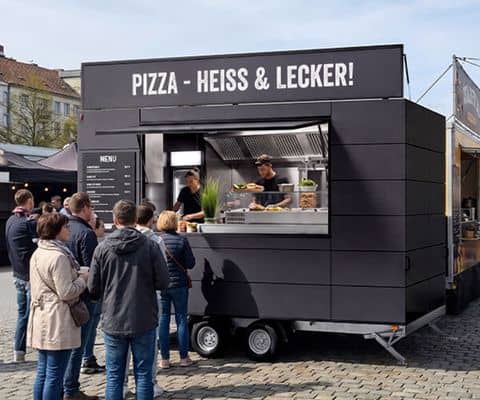






Setting Up a Snack Bar: Planning the Equipment Based on Your Own Concept
Professional fast-food equipment includes the appliances and work areas needed for storage, preparation, cooking, keeping food warm, serving, and cleaning. Which equipment takes center stage depends directly on the specific menu offerings. A French fry and currywurst stand operates differently from a burger concept, a snack bar serving sandwiches, or an establishment that also offers pizza, döner, or soups. What these concepts have in common, however, is a high number of recurring work steps. Especially at lunchtime or in the evening, many orders must be prepared and served within a short period of time. That’s why, in a snack bar, it’s not just the performance of a single piece of equipment that matters. What’s crucial is whether ingredients, cooking techniques, work surfaces, packaging, and service are integrated into the shortest possible production chain.
Tailor the deep fryer, griddle, and grill equipment to the product line
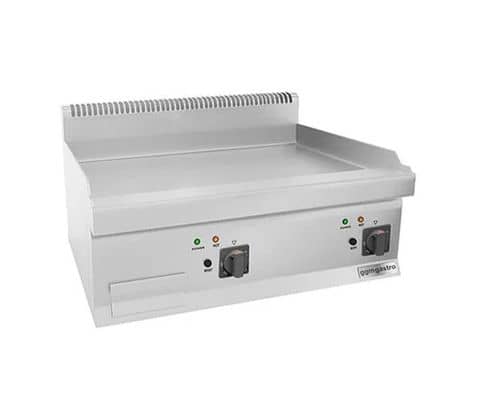
In many snack bars, hot food preparation is the heart of the kitchen. Deep fryers are suitable for french fries and other fried items, while griddles can be used for burgers, meat, vegetables, or other quickly cooked dishes. Contact grills, sausage grills, or other specialty appliances round out the lineup depending on the menu. When making a selection, the actual workload during peak hours is the most important factor. A deep fryer must not only be able to handle the daily volume but also the concentrated demand during the busiest ordering periods.
The same applies to griddle and grill surfaces. A station that’s undersized results in individual components having to wait for one another. Oversized appliances, on the other hand, take up valuable counter space and tie up budget without necessarily providing additional benefits in day-to-day operations. The combination of appliances is also important. French fries, bratwurst, and burgers can be ordered at the same time. If the deep fryer, grill, and serving area are poorly positioned relative to one another, staff will have to cross paths precisely when they need to work quickly.
Bringing Cooling and Preparation Right to the Worksite
A quick bite to eat requires not only cooking skills but also well-organized mise en place. Salads, sauces, cheese, vegetables, meat products, and other prepared ingredients must be stored hygienically and be quickly accessible during service. Salad stations & prep tables combine refrigerated storage and counter space right at the production station. Especially for burgers, sandwiches, salads, or other dishes with multiple chilled components, a logically organized assembly station reduces unnecessary movement. Refrigerated base units can also combine valuable counter space with refrigeration close to the production area. Larger stock, on the other hand, remains in the storage refrigeration. This creates a clear separation: daily and service requirements are located close to production, while reserves are kept outside the main workflow. This structure is particularly important in small spaces. Frequently used ingredients should be within easy reach; items needed only rarely do not have to take up the most valuable space at the production station.
Quick Checklist for Choosing the Right Snack Bar Equipment
Five points can help narrow down the equipment you need:
- Product Line: Which core products are sold in large quantities every day?
- Peak Load: How many orders must be processed during the busiest 30 to 60 minutes?
- Cooking Methods: Which products are deep-fried, pan-fried, grilled, reheated, or assembled cold?
- Space: How can refrigeration, cooking equipment, preparation, and service be arranged to minimize walking distances?
- Sales Channels: What are the proportions of dine-in, takeout, and delivery?
These factors usually provide much clearer guidance than simply the number of dishes offered.
Integrating food warming into the production flow in a targeted manner
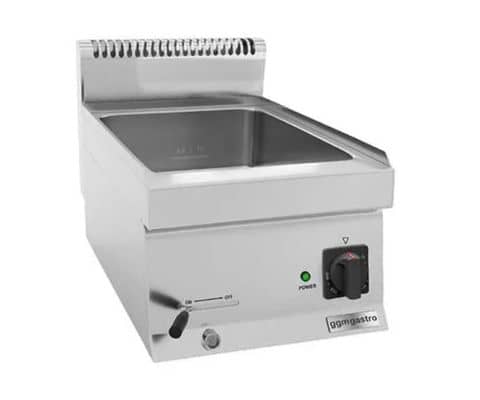
Not every product can or should be produced entirely in advance. Nevertheless, food-warming solutions can help snack bars keep individual items on hand during peak hours. French fry warmers and fry pans, for example, help streamline operations around the fry station. Bain-Maries can be used for suitable hot items that need to remain available during service. It is crucial not to view food warming as a substitute for sufficient production capacity. Products vary significantly in how well they maintain their quality over a certain holding time. The warming strategy must therefore be tailored to the specific menu and the actual order frequency. Coordination is especially crucial in a fast-paced business: If too much is prepared too early, quality and food costs may suffer. If production is based exclusively on orders, high demand may result in unnecessary wait times.
Make the most of a compact space with short walking distances
Many snack bars operate in relatively small spaces. That is precisely why the layout of the equipment has a major impact on the daily workload. Ideally, the layout should follow the production flow: retrieving chilled ingredients, preparing or assembling them, cooking, adding finishing touches, packaging, and serving. Frequent tasks should require as few steps and turns as possible. Work surfaces between heavily used appliances are not just unused spaces; they provide room for containers, plates, packaging, and temporary hand-offs. Stainless steel furniture can provide additional work and storage surfaces while also serving as a sturdy foundation for high-traffic areas. When there are multiple employees, it’s also important to consider whether they can work in parallel. If one person at the deep fryer automatically blocks the path to the cooling area or serving counter, the same bottleneck occurs during every peak period.
Complementing Different Snack Specialties in a Meaningful Way
For many snack bars, a wide product range is a key part of their business model. In addition to french fries, currywurst, or burgers, they may also offer soups, sandwiches, pizza, or other snack items. However, each additional product category doesn’t just expand the selection for customers. It may also lead to additional raw materials, storage space, preparation steps, and equipment requirements. Expansions therefore work particularly well when they can be integrated into the existing production structure. An additional product that utilizes existing refrigeration areas, work surfaces, and serving stations creates less complexity than a new product category with its own dedicated production line. When it comes to equipment, a clear distinction between core technology and specialized technology is therefore helpful. Core technology accounts for a significant portion of daily business. Specialized equipment makes sense when the corresponding food category is sold frequently enough to justify the space and investment from an operational standpoint.
Plan for takeout and quick service from the very beginning
At a snack bar, serving is often a particularly brief but crucial part of the process. Food is prepared, topped with sauces or side dishes as needed, packaged, inspected, and handed over immediately. To-Go & Packaging therefore need a designated spot within or immediately next to the pickup station. Bags, trays, boxes, napkins, and cutlery should be quickly accessible without taking up space on the actual food preparation area. This separation becomes even more important when a higher proportion of orders are for delivery. Guests picking up orders, delivery drivers, and dine-in customers should interfere with one another as little as possible. A clearly defined handoff zone can help remove completed orders from the production area. Beverage refrigerators can also be integrated into this workflow. If beverages are frequently sold alongside food, quick access is beneficial without interrupting the hot food production line.
Planning Hygiene and Cleaning for a Busy Daily Routine
Grease, heat, food scraps, and constantly used work surfaces are all part of a typical snack bar operation. That’s why the ease of cleaning the equipment directly affects the daily workload. Easily accessible surfaces, uncluttered shelves, and sufficient space between or under appliances make cleaning after service easier. Particularly when it comes to deep fryers and griddles, it’s important to consider how grease and food residue can be removed and how accessible the equipment remains during daily use. Used GN containers, utensils, knives, and dishes must also be made available again quickly. Properly sized dishwashing equipment helps ensure that dish return and cleaning do not interfere with ongoing food preparation. Furthermore, the more heavily fryers, griddles, or grilling equipment are used, the more important it is to have a ventilation and exhaust system that is appropriately sized for the actual workload.
Prioritizing Snack Bar Equipment Based on Cost-Effectiveness
When opening a new location, it’s not necessary to have every conceivable category of equipment available right away. It makes sense to start with equipment that reliably covers the most important revenue drivers. A concept focused heavily on french fries and currywurst has different priorities than a burger joint or a snack bar that primarily serves cold and hot sandwiches. Investments in core processes—cooking capacity, preparation, refrigeration, and serving—therefore usually take precedence over equipment for rarely sold add-on items. Even when modernizing, it’s worth taking a close look at the actual bottleneck. If orders take a long time, the problem isn’t automatically due to a fryer that’s too small. Perhaps there’s a lack of counter space, ingredients are too far away, the assembly station is poorly organized, or packaging is blocking the serving area. A suitable investment, therefore, does more than simply improve the technical equipment. It reduces friction precisely where time, capacity, or labor are regularly lost during daily operations.
Professional Equipment for Snack Bars with GGM Gastro
From small snack bars to versatile eateries with strong lunch, takeout, or delivery operations, different requirements arise for the kitchen and service areas. The menu selection, order volume, floor space, and workflow determine which equipment works best together in each establishment. GGM Gastro offers catering equipment ranging from deep fryers, griddles, and grills to salad stations, refrigerated base units, and beverage coolers, as well as food warming systems, work surfaces, packaging solutions, and dishwashing equipment. This allows both new openings as well as renovations and expansions to be planned in line with actual operational workflows.