


:quality(70))
:quality(70))


Meatball Molds for Professional Food Service
Meatball presses make it easier to portion and shape ground meat evenly for repetitive production processes. A variety of diameters and portion sizes provide the right choice for snack bars, restaurants, catering services, and other commercial kitchens. Meatball Press Guide »
Width
Price
Meatball Molds for Consistent Portions in Everyday Restaurant Operations
Meatball presses are manual kitchen tools used to quickly shape prepared portions of ground meat into uniform, round shapes. They are particularly well-suited for food service establishments where meatballs or burger patties are prepared regularly and need to be portioned as consistently as possible.
In day-to-day operations, the right meatball press primarily supports standardization. Consistent diameters and defined portion sizes make it easier for the team to produce comparable results, even with a changing staff. This is particularly important, for example, in snack bars, burger chains, restaurants, food trucks, or catering kitchens, where large quantities are prepared during mise en place.
When making a selection, four criteria should be considered above all: desired diameter, portion weight, number of portions that can be formed simultaneously, and cleaning effort. The product range includes models with diameters of approximately 80, 100, and 120 mm. The corresponding portion sizes are approximately 85, 125, and 175 g, respectively.
What size meatball press fits your business model?
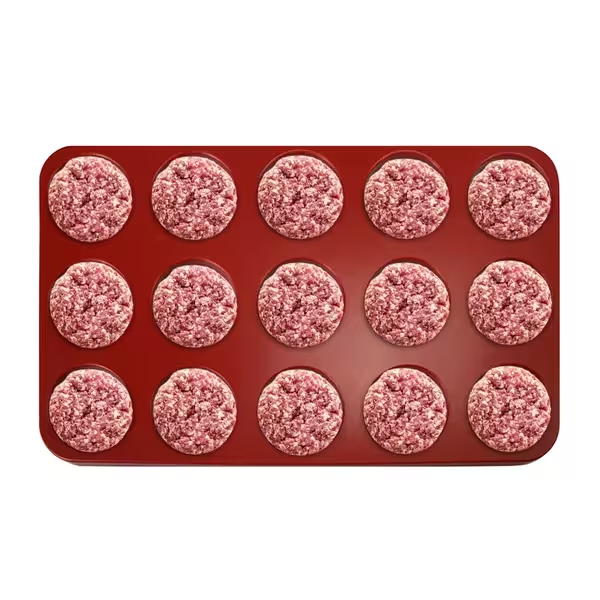
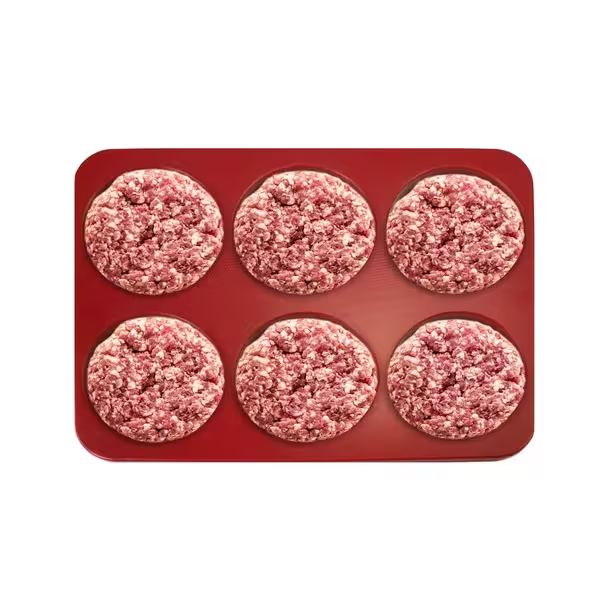
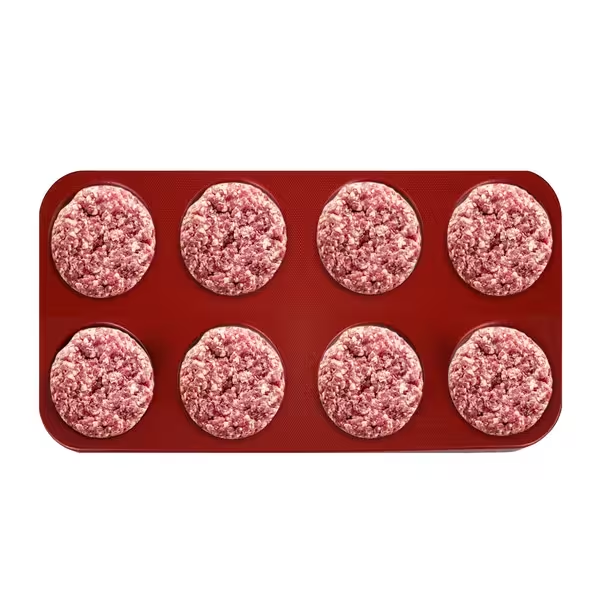
The appropriate size should not be determined solely by the desire for the largest possible portions, but rather by the menu, cost calculations, and existing production standards. A press with an 80-mm diameter is suitable for smaller portions of about 85 g and has 15 molds. The 100-mm model features eight molds and is designed for portions of about 125 g. The 120-mm model offers six molds for meatballs or patties weighing approximately 175 g.
This allows you to base your choice directly on the desired portion size. If you already use defined recipes and portion weights, you should check these before purchasing. This prevents a new piece of equipment from unnecessarily altering your existing portioning system.
Quick Checklist for Selection:
-
What weight should each meatball be?
-
What diameter is appropriate for the dish or roll being served?
-
How many portions should be prepared per production run?
-
How often is the press used in day-to-day operations?
-
Can it be easily integrated into the existing prep area?
Integrate preparation efficiently into the workflow
The greatest practical benefit is realized during predictable preparation phases. Instead of estimating each portion individually during peak hours and shaping them differently by hand, part of the work can be completed in a standardized manner before service begins. This helps ensure smoother operations and reduces avoidable variations among individual employees.
The press does not require a permanent installation and can be used flexibly on any suitable work surface. It is important to have sufficient space for ground meat, the press, finished portions, and subsequent refrigerated storage. A neatly organized workspace with [stainless steel furniture] and [refrigerated tables] located close to the production area can help minimize the distance between portioning and refrigeration.
Especially in compact kitchens, the meatball press should be easy to store away after use. The work surface should not be permanently blocked by equipment or tools that are only needed during specific preparation steps.
Materials, Cleaning, and Hygiene for Meatball Molds
The meatball presses offered are made of durable plastic and feature several round molds as well as a matching pusher. Since they are used directly in meat processing, easy and thorough cleaning is particularly important in a commercial setting.
Meat residue should not be left on molds, edges, or pressing surfaces for any longer than necessary. Therefore, prompt cleaning in accordance with the facility’s hygiene guidelines is recommended after each use. Easily accessible surfaces facilitate this daily routine.
The work area surrounding the portioning process should also be integrated into the hygiene plan. Clean work surfaces, refrigerated temporary storage, and a clear separation between preparation areas and non-clean work routes support traceable processes. When planning larger kitchens, appropriately arranged sink units can further help to systematically separate cleaning and return processes from the production area.
Standardized Portioning as an Economic Factor
A meatball press is a relatively simple piece of equipment, but it can have a tangible impact on daily production routines. If portions are consistently sized at, for example, 85, 125, or 175 g, it is easier to track and control food costs than when portion sizes fluctuate widely.
Uniform patties also ensure consistent cooking conditions and a more uniform appearance when served. The economic benefit does not come from the tool alone, but from its integration into clear recipes, defined weights, and repeatable workflows.
For establishments with regular demand, therefore, the most important factor is not having the most extensive equipment possible, but rather a meat patty press whose size and capacity match the actual production volume.
Choose meatball presses that are right for your business
A sensible choice depends on portion weight, diameter, production volume, and available workspace. The various models, ranging from 80 to 120 mm, allow you to tailor the meatball press to different menus and business models.
By defining portion sizes in advance, organizing the prep area efficiently, and factoring in cleaning and refrigeration, you create a solid foundation for more consistent workflows. This makes the meatball press a straightforward tool for structured and reproducible preparation.