


Sink Units for the Food Service Industry and Commercial Kitchens
Sink tables are sturdy stainless steel workstations designed for dishwashing, food preparation, and hygienic kitchen operations. They help food service establishments clean dishes, cooking utensils, and equipment in a clean, efficient, and space-saving manner. Guide to Sink Tables »
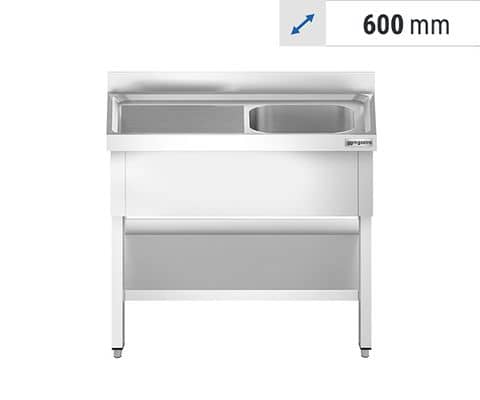
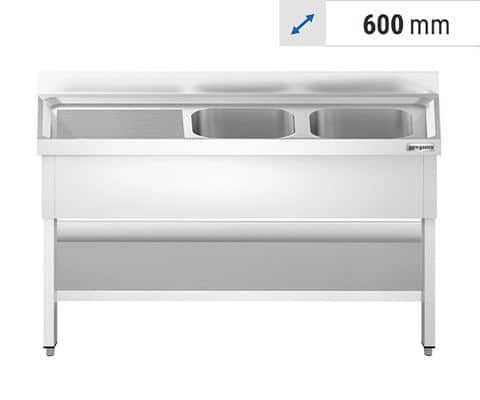

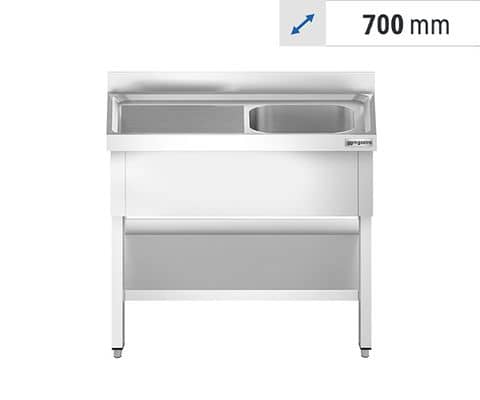
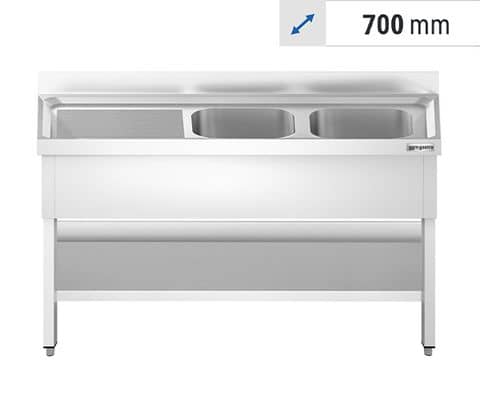
Sink units as a solid foundation for clean kitchen operations
Sink units are stainless steel sinks with one or more basins that are used in professional kitchens for cleaning, pre-rinsing, soaking, and sorting dishes, pots, GN containers, and kitchen utensils. In restaurants, fast-food joints, hotels, cafeterias, cafés, and catering services, they play a key role in the dishwashing area and help clearly separate dirty and clean work areas.
In day-to-day operations, a properly selected sink area determines more than just the available washing space. It also influences traffic flow, return processes, work pace, and hygiene. Especially during peak hours, when cookware, plates, and containers need to be made available quickly, a sink area that’s too small can quickly become a bottleneck. A well-integrated sink, on the other hand, keeps the return process organized and reduces the team’s workload when it comes to recurring cleaning tasks.
Which Sink Tables Are Right for Your Business
The most important question to consider is: How much dishwashing volume is generated during normal operations, and how much space is available? For small kitchens, cafés, or snack bars, a single-bowl sink can be a cost-effective solution if the primary items being washed are dishes, small containers, or kitchen utensils. In restaurants, commercial kitchens, or establishments with a high volume of cookware, models with two sinks are often more practical because pre-rinsing, soaking, and final rinsing can be organized separately.
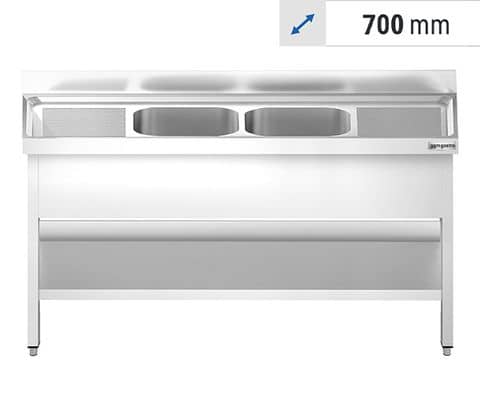
Dimensions are also crucial. Sink units with a depth of 600 mm are suitable for compact kitchen islands and tight workspaces. Models with a depth of 700 mm offer more room to move, larger basins, and more convenient storage. The width should be chosen not only based on available space, but also on the direction of work flow, the volume of return water, and the basin position. A basin on the left or right can determine whether dishes can reach the dishwasher, the drying rack, or the next cleaning station without unnecessary back-and-forth movement.
A quick check can help with your selection:
-
One sink for smaller loads and compact kitchens
-
Two sinks for pre-rinsing, soaking, and parallel tasks
-
600 mm depth for limited space, 700 mm depth for greater working comfort
-
Upstand for wall-mounted installation and areas prone to splashing
-
Base shelf if additional storage space is needed for baskets, buckets, or cleaning supplies
Stainless Steel, Hygiene, and Durability in Daily Use
Sink tables are constantly exposed to water, cleaning agents, food scraps, grease, and mechanical stress. That is why stainless steel is the ideal material for professional use. The smooth surfaces are easy to clean, moisture-resistant, and support hygienic workflows in areas where dishes are regularly washed, sorted, and wiped down.
Sturdy basins, cleanly finished edges, durable work surfaces, and stable legs are essential. Height-adjustable legs make it easier to adapt to uneven floors and help integrate the sink unit neatly into a kitchen layout. An upstand protects the wall from splashing water and makes it easier to clean behind the sink area. A base shelf provides additional storage space but should be used in a way that keeps cleaning paths clear and prevents the creation of hard-to-reach areas where dirt can accumulate.
The plumbing layout should also be reviewed early on. The water supply, drain, siphon, wall clearance, and position relative to the dishwasher must be compatible with the existing infrastructure.
Integrating Sink Tables Properly into the Workflow
A sink works best when it is not isolated but integrated into a clear washing and return flow system. Dirty dishes should arrive directly, be pre-rinsed, and then move on in an orderly fashion. In a small pizzeria, this might mean that baking sheets, scoops, and containers are collected and cleaned immediately after use. In a hotel kitchen, the sink can be part of a larger return system in which trays, GN containers, and cookware are handled separately.
It makes sense to combine this with matching dishwashers, dishwashing cabinets, and stainless steel cabinets. Additional work tables provide extra space for sorting or setting items aside. For larger dishwashing volumes, connecting to dishwashing tables for dishwashers may be relevant if inlet and outlet sinks are intended to support the machine-based dishwashing process.
It is important to maintain a clear distinction: A classic dishwashing sink is not a substitute for a dishwasher, nor is it a closed dishwashing cabinet. It is an open, durable workstation for manual dishwashing and food preparation. This makes it particularly suitable for businesses that require sturdy stainless steel surfaces, direct access to the sink basin, and flexible use in wet areas.
Plan for economic efficiency rather than just filling space
A sink is a simple piece of equipment, but it has a significant impact on day-to-day operations. When the flow of dishes slows down, supplies are missing, or dishes are collected haphazardly, it results in wasted time, disruption, and extra trips. A properly sized sink can reduce this friction because the basins, storage, and workflow are tailored to actual usage.
For operators, therefore, the purchase price isn’t the only deciding factor. What’s more important is whether the sink fits the volume of dishes, the kitchen space, the team, and the intended use. Those working in compact spaces need clear dimensions and easy cleaning. Those handling large volumes daily should pay closer attention to the number of basins, depth, counter space, and sturdy construction.
In this way, sink units become a functional building block for hygienic, smooth, and resilient kitchen operations. At GGM Gastro, businesses can find a variety of designs for small dishwashing stations, classic restaurant kitchens, and high-traffic work areas—with options tailored to space, usage, and professional needs.