


Fish Market Equipment for Professional Businesses
From refrigerated storage to product display on ice to quick service at the fish counter: Well-designed fish market equipment supports a controlled cold chain, hygienic workflows, and an appealing product presentation. The specific equipment needed depends primarily on the product range, sales volume, in-house processing, and additional offerings such as smoked fish or hot fish dishes. Guide to Fish Market Equipment »



Setting Up a Fish Shop: Planning the Layout Around the Merchandise
Professional fish market equipment includes appliances and work areas for refrigeration, storage, preparation, presentation, sales, and cleaning. Depending on the business, processing, smoking, or the preparation of hot meals may also be required. A traditional specialty fish shop with a fresh fish counter has different requirements than a business that also produces smoked goods, sells fish sandwiches, or offers hot meals. Consequently, refrigeration capacity, work surfaces, and production technology vary accordingly. A clear flow of goods is therefore helpful for planning: Goods are received and stored in a refrigerated state, prepared for sale, displayed at the counter, and restocked throughout the day. Work equipment, packaging materials, and cleaning areas must support this process without allowing refrigerated goods to remain outside the designated areas for unnecessarily long periods.
Fish counters as the centerpiece of the sales area
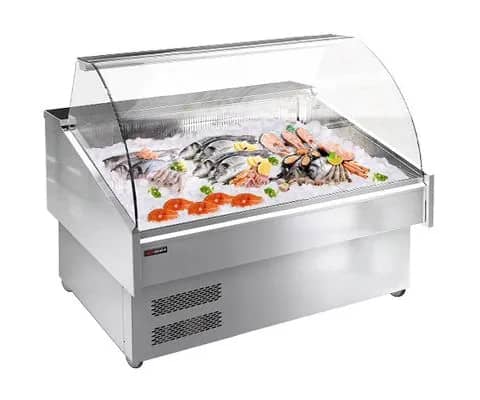
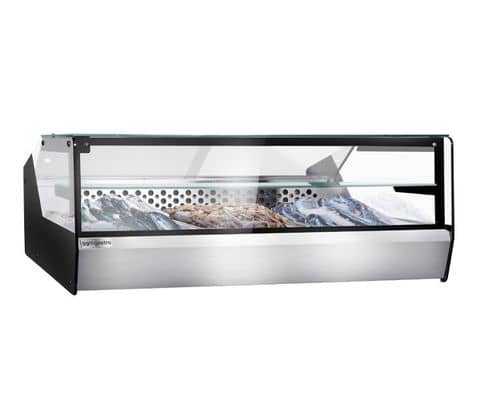
Fish counters combine refrigeration, product display, and counter service. For customers, the counter is the central focal point for viewing the product selection; for employees, it also serves as their daily workspace. Therefore, when selecting a counter, it’s not just about width and appearance. The most important factors are the usable display area, the intended temperature range, accessibility from the service side, and the ability to thoroughly clean the counter during daily operations. A wide selection of whole fish, fillets, seafood, and prepared products requires a correspondingly large display area. However, a larger counter also increases the effort required for stocking, restocking, and maintaining the display. The size should therefore match the actual product assortment. A compact, fully stocked fish counter can be more practical in operation than an oversized display that unnecessarily ties up space and requires additional merchandise for presentation.
Plan for flake ice in your presentation and work organization
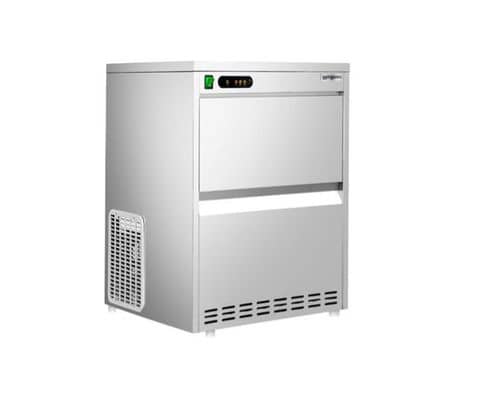
At many fish counters, ice is an essential part of product presentation. Flake ice machines or crushed ice machines make it possible to regularly provide fresh ice for the display and other operational uses. Daily demand is the key factor in determining the appropriate size of the machine. It’s not just the initial morning stock that matters. During the sales day, ice may need to be replenished or the display may need to be rearranged. The location of the ice machine also plays a role. If it is located far from the counter and the preparation area, this results in additional trips carrying containers and ice. A well-planned location reduces these repetitive movements. In addition to production capacity, the planning process should therefore take into account containers, transport routes, water and electrical connections, as well as the space surrounding the machine.
Don't limit cooling to the sales counter
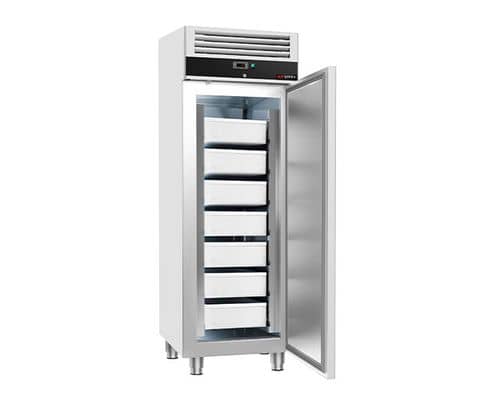
The display case for fish is not a substitute for adequate storage refrigeration. The stock on display represents only a portion of the merchandise, while reserves and, if applicable, frozen products are stored separately. Fish Refrigerators & Freezers support structured storage in the backroom. The required capacity depends, among other things, on inventory turnover, delivery intervals, the breadth of the product range, and the ratio of fresh to frozen goods. Clear storage organization is especially important for perishable goods. Products that are restocked frequently should be as easily accessible as possible. Larger stock reserves can be stored further away from the immediate sales area. This creates a clear separation between display stock and inventory, without requiring employees to walk unnecessarily long distances for each restocking.
Quick Checklist for Choosing the Right Fish Market Equipment
Here are five points to help narrow down your actual needs:
- Product range: Do you offer fresh fish, fillets, seafood, smoked products, or frozen items?
- Sales volume: How much product needs to be displayed and restocked during peak sales times?
- Refrigeration setup: What capacity is needed for sales, stock, and frozen goods?
- In-Store Processing: Are products portioned, further processed, smoked, or prepared hot on-site?
- Sales Concept: Is the focus on counter service, or are fish sandwiches, snacks, and hot meals a regular part of the offering?
These factors determine which equipment forms the core of the fish shop and which devices become relevant only through additional production or sales areas.
Organize food preparation and portioning to minimize movement
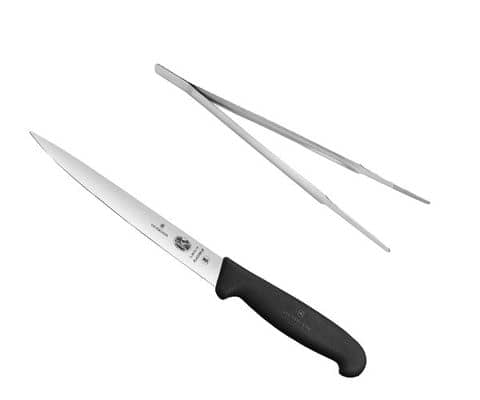
Depending on the product range, various steps are required before the presentation or immediately at the time of sale. Fish, for example, is prepared, portioned, or assembled according to customer orders and then packaged. To do this, the business needs sufficient workspace located conveniently close to the refrigeration units and the sales counter. Knives, cutting surfaces, containers, and packaging materials should be clearly organized and easily accessible. It is particularly important to keep different tasks separate. If product preparation, packaging, and general storage are constantly taking place in the same small area, you’ll have to keep rearranging things during peak sales periods. A dedicated workstation reduces this friction. Frequently used tools are located directly at the workstation, while prepared goods can be returned directly to the refrigeration unit or the sales area without detours.
Plan ahead for restocking the fish counter
A well-stocked sales counter requires an efficient restocking system. What matters isn’t just how much inventory is available, but how quickly it can be moved from cold storage to the sales area. Especially during busy weekends or seasonal peaks, the volume of activity can increase significantly. That’s when customer service, portioning, packaging, and restocking all happen simultaneously. A clearly defined handoff point between storage and the counter helps keep these processes separate. Reserve containers and frequently requested products should be organized in such a way that service is interrupted as little as possible. The key is not to maximize stock directly behind the counter. Too much merchandise and too many containers in a confined space can impair visibility and freedom of movement just as much as insufficient reserves.
Integrate flash freezing into a suitable operating model
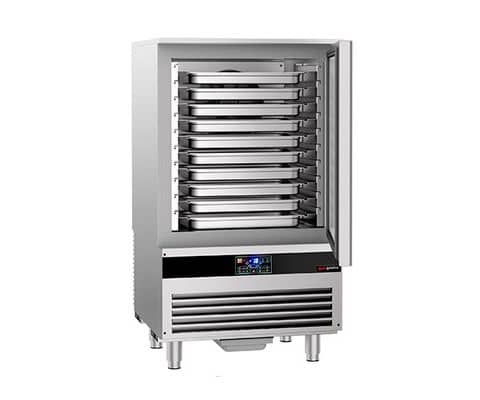
A blast chiller may be of interest to fish processing facilities if their production and storage plan requires a rapid drop in temperature for specific products. Whether such technology makes sense depends heavily on the product range and in-house processing. A business that sells only fresh fish has different needs than one that processes, prepares, or stocks larger quantities for later production steps. It is therefore important not to select blast chilling or blast freezing technology in isolation. The capacity must match the volume of goods actually processed as well as the subsequent refrigerated or frozen storage requirements. Space requirements and the distances between the preparation area, the equipment, and further storage areas must also be taken into account.
Consider smoked fish as a separate production line
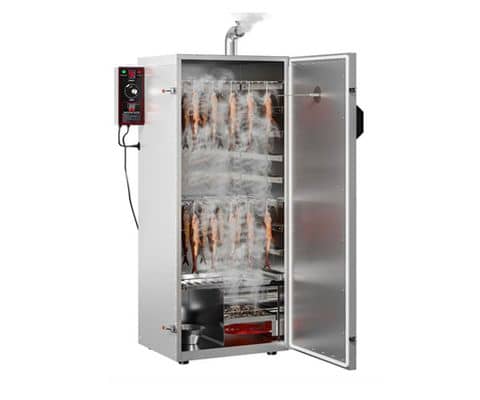
Smoked salmon, trout, mackerel, and other smoked products can expand a specialty fish shop’s product line. However, in-house production requires an additional production area. Smoking ovens require a suitable location and integration into the existing technical infrastructure, depending on the model and operating system. Preparation, the smoking process, subsequent storage, and sales must be viewed as a cohesive workflow. Those who smoke individual products only occasionally have different requirements than a business with an extensive in-house smoked product line. Capacity planning therefore differs significantly as well. The appropriate technology depends on the actual planned batches and not solely on how broad the product range could theoretically be.
Plan hot fish dishes separately from the fresh fish sales
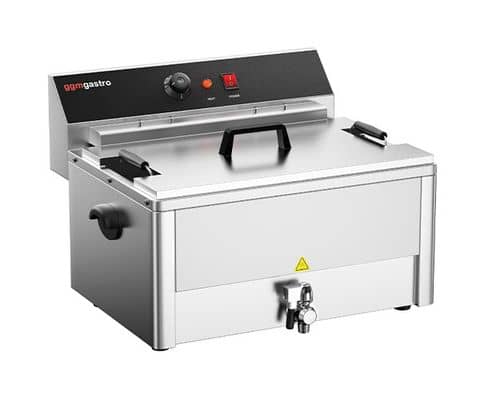
Some fish shops combine traditional sales with fish sandwiches, fried fish, French fries, or other hot dishes. This creates a second production process in addition to the refrigeration and sales line. Fish fryers and special deep-fry ovens can be used for such concepts. Added to this are preparation, hot food production, packaging, and serving. This area requires a sensible physical separation from the fresh fish sales section. Heat, grease, and ongoing cooking processes place different demands on work surfaces, ventilation, and cleaning than the refrigerated fish counter does. This separation is also beneficial from an organizational standpoint. If the same person has to portion fresh fish, operate the deep fryer, and package orders all at the same time, a bottleneck can occur even with moderate customer traffic. Therefore, if a high proportion of the menu consists of snacks, the hot food service area should be planned as a separate workstation rather than simply attached to the existing sales counter.
Pack and ring up items without slowing down counter operations
After selection and portioning, packaging often follows in the fish market. Paper, bags, trays, or other suitable packaging materials need designated spots right next to the corresponding work area. Scales and the point-of-sale system should also be positioned so that orders can be completed without unnecessary back-and-forth movements. If several people are working behind the counter, the layout becomes particularly important. One person should be able to package or ring up an order without simultaneously blocking a second person’s access to the merchandise. For curbside pickup orders or pre-prepared selections, a clearly defined handoff zone can also be helpful. This keeps orders that have already been assembled out of the active service line.
Hygiene and cleaning are a big part of daily life at the fish market
When handling fresh fish and seafood, cleaning, moisture, and regular contact with ice or water are part of everyday operations. The equipment must therefore not only be functional but also easily accessible and arranged in a way that facilitates cleaning. Work surfaces, knives, containers, and areas that come into contact with the product require strict cleaning routines. The fish counter itself must also be integrated into the daily workflow in such a way that both the display area and interior spaces can be reliably maintained. For example, in some professional fish counters, drainage channels in the refrigerated compartment and accessible front panels facilitate practical cleaning. However, the specific design varies between models. Equally important is the organization of the return process. Used containers and tools should not be left on the preparation or sales area until there is no more space available. A clear path from use to cleaning and back to the workstation supports a well-organized workflow.
Sizing Cooling Systems and Work Areas Based on Peak Load
Even in a fish market, an average day isn’t always the best benchmark for determining the necessary equipment. Weekends, holidays, or seasonal demand can lead to significantly higher sales volumes. In such cases, several areas must keep up simultaneously: inventory, the fish counter, ice supply, restocking, portioning, and packaging. For example, a large fish counter is of little use if the reserve refrigeration capacity doesn’t match the sales volume. Similarly, a high-performance ice machine is of little use if the transport and storage of the ice produced are poorly organized. Capacity should therefore be viewed as an entire chain. A bottleneck at one station can limit the performance of the rest of the equipment.
Prioritizing Fish Market Equipment Based on Cost-Effectiveness
When opening a new location, priority should first be given to the areas that are immediately necessary for product quality and sales on a daily basis: adequate refrigeration, product display, ice supply, workspace, and a clearly organized service area. Additional equipment depends on the actual business model. Having a dedicated smoker is particularly important if smoked products are a core part of the menu. Fried foods, on the other hand, only require their own high-capacity production station once the hot food section regularly reaches the necessary volume. Therefore, when modernizing, the first step is to identify the actual bottleneck. Is there a lack of display space? Is backup refrigeration insufficient? Does restocking take too long? Is there not enough ice? Or are packaging and hot food preparation hindering service at the fish counter? An economically sound investment addresses the areas where time, capacity, or counter space are regularly lost during daily operations.
Equip Your Fish Market Professionally with GGM Gastro
From traditional fish markets to businesses with their own smoking facilities to fish shops offering additional snacks, product assortments and workflows vary significantly. The right equipment is therefore determined by the volume of merchandise, refrigeration needs, display space, in-house processing, and planned sales. GGM Gastro offers equipment for this purpose, ranging from fish counters and fish refrigeration technology to flake and crushed ice machines, blast freezers, smoking ovens, and equipment for preparing hot fish dishes. This allows for the targeted configuration of both the core areas of a new establishment and individual refrigeration, sales, or production stations during modernization and expansion.