


Cafeteria Equipment for Professional Institutional Food Service
From commercial kitchen equipment and refrigeration to food holding, self-service lines, and dishwashing stations: Well-designed cafeteria equipment combines high-volume production with predictable workflows and fast service. The choice of equipment depends primarily on the daily number of meals served, the menu, serving times, the production model, and the available space. Cafeteria Equipment Guide »
Self-service for canteens







Kitchen & refrigeration equipment






Other Equipment







Setting Up a Cafeteria: Planning from Meal Counts to the Overall Process
Professional cafeteria equipment includes appliances and workstations for storage, preparation, production, keeping food warm, serving, dish return, and cleaning. It is used, among other places, in company cafeterias, university dining halls, and other institutional food service facilities. Unlike in a traditional à la carte restaurant, demand often arises within easily predictable time windows. For example, several hundred meals can be prepared in the morning, while the actual serving takes place mainly between 11:30 a.m. and 1:30 p.m. This shifts the planning process. Not every dish needs to be prepared individually upon order. Instead, what matters are batch sizes, container organization, keeping food warm, restocking, and a serving line capable of handling many guests in a short amount of time. The most important planning factor is therefore not just the number of seats, but the number of meals served per service period.
Adjust production to match quantities and the meal plan
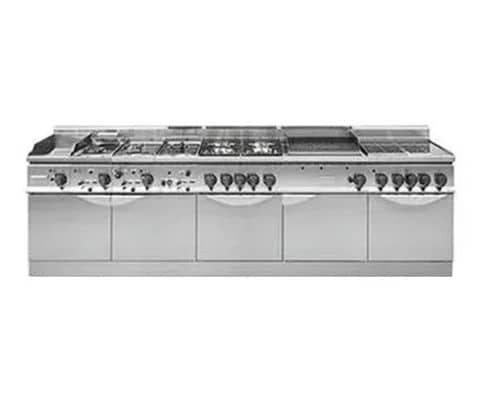
Cafeterias often rely on recurring menus and larger production batches. Accordingly, the most important cooking appliances must be designed to handle the daily volume. Combi ovens can handle various cooking processes and process multiple GN containers or batches simultaneously. Depending on the menu, stock pots are suitable for preparing large quantities of soups, sauces, side dishes, or other appropriate dishes. Tilting fryers, in turn, can play a central role in production processes involving large quantities. The specific equipment needed is determined by the menu. A cafeteria with a high proportion of stews, sauces, and cooked side dishes requires different capacities than an operation with a stronger focus on oven-baked dishes, vegetables, meat dishes, or freshly prepared meals. The equipment should therefore be sized not individually, but as a unified production line.
Calculate capacity based on the peak output window
A daily average can be misleading when planning a cafeteria. The key factor is how many servings must be produced, prepared, and served during the busiest time window. If 600 guests eat primarily within a 90-minute period, the demands on serving and restocking are significantly higher than if the same daily volume were spread over several hours. Production must also support this rhythm. A piece of equipment may theoretically have sufficient daily capacity but still be too small if multiple components are needed simultaneously for the same serving wave. That’s why it’s worth breaking it down by food group: How many servings need to be prepared? In which containers are they produced? When must they be ready? And how are they then transported to the serving area? This volume-based approach results in a significantly more robust equipment sizing strategy.
Quick Checklist for Choosing the Right Cafeteria Equipment
Five points provide a good framework for planning:
- Number of meals: How many servings are needed daily and during the busiest serving window?
- Production model: Is all cooking, preparation, and reheating done on-site, or is a hybrid model used?
- Menu: Which cooking methods and food groups are regularly prepared in large quantities?
- Service format: Is food served via self-service, staffed service, or multiple parallel stations?
- Dishware Return: What volume of trays, plates, cutlery, and GN containers needs to be washed within a short period of time?
These factors highlight where large capacities are necessary and which areas can be planned in a modular or more compact manner.
Separate the Workload Between Preparation and Mass Production
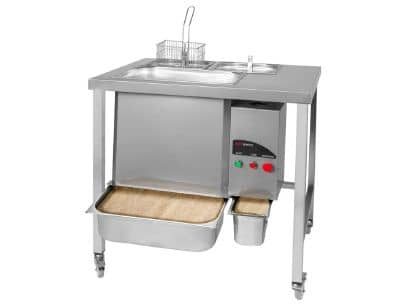
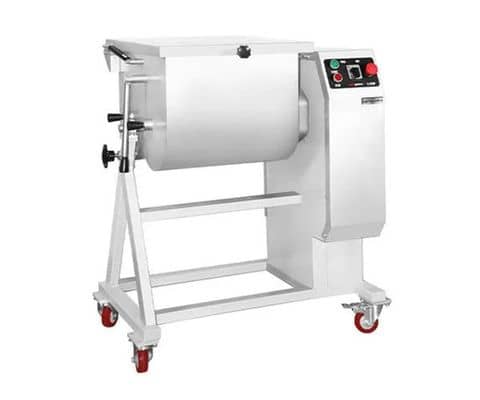
Before cooking begins, a lot of prep work often needs to be done in a cafeteria. Vegetables need to be cut, ingredients portioned out, and other components prepared. Vegetable cutters & cheese graters can help with these repetitive tasks when dealing with large volumes. Potato peelers and cutters, or other processing equipment, are also useful where the corresponding raw ingredients are regularly processed in large quantities. The key factor is which tasks actually tie up staff time on a daily basis. A specialized device that is used only occasionally takes up space and strains the budget. Recurring preparation steps involving large quantities, on the other hand, can be suitable candidates for mechanization and standardization. Sufficient workspace and temporary storage area are also part of this consideration. Prepared food must then be able to be transferred in a controlled manner to refrigeration or production.
Use cold storage rooms for inventory and pre-production
A cafeteria's higher production volume often leads to increased storage needs. Cold storage rooms & refrigeration units can accommodate larger quantities of raw ingredients, prepared components, and other products that require refrigeration. The required size depends, among other things, on delivery intervals, the menu, and production methods. It’s not just the sheer volume that matters. The cold storage layout should be organized so that frequently used items are easily accessible and larger containers or bins can be stored efficiently. Pre-production also affects refrigeration needs. If components are prepared the day before or production steps are staggered, there is an additional need for refrigerated interim storage. The routes between storage, preparation, and the cooking area should therefore remain as short and logical as possible.
Incorporating Rapid Cooling into Time-Decoupled Production Models
Depending on their production system, cafeterias may rely more heavily on advance preparation and subsequent serving. Blast freezers or similar rapid-cooling technology can be part of a controlled process there, where prepared meals are quickly cooled and then stored for further processing steps. The entire chain is always crucial here. Production, cooling, storage capacity, subsequent reheating, and serving must be quantitatively aligned. A high-performance individual unit alone does not guarantee a functioning cook-and-chill process. Container sizes and production batches also influence the required capacity. For production of exclusively fresh food intended for immediate service, however, the priorities may differ. The technology should therefore be based on the actual production model rather than on the most extensive list of equipment possible.
Keeping food warm as a link between the kitchen and the serving area
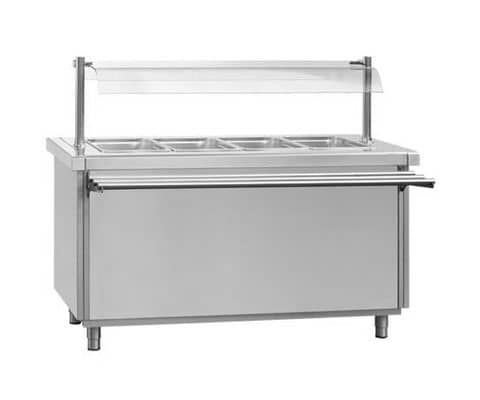
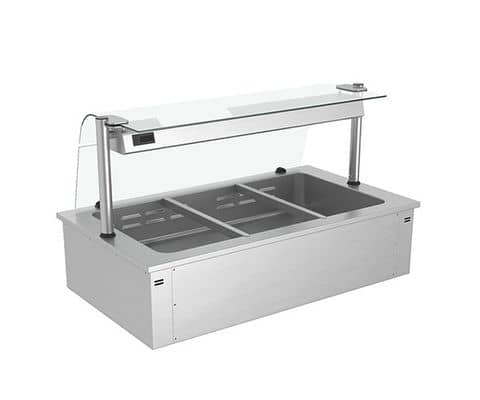
There may be a certain amount of time between when a meal is prepared and when it reaches the guest in the cafeteria. Heated Carts & Bain-Maries can help keep suitable meals at the proper temperature between preparation and service or transport them to the serving station. The restocking strategy is particularly important. It is not necessary for the entire lunch portion to be on the serving counter at the same time. Smaller quantities can be continuously replenished from the reserve. This allows for more organized serving, and the contents of individual containers remain on the serving line for a shorter period of time. The warming process should always be adapted to the specific dish. Not every dish can withstand the same standing time equally well. Production planning therefore determines when each batch is completed and brought to the serving station.
Understanding Self-Service as a Distinct Stage of Production
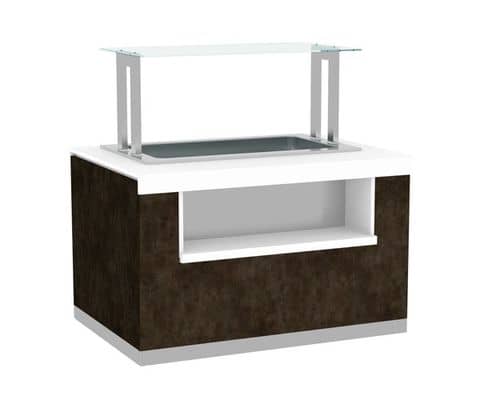
The self-service line for cafeterias serves as the interface between the kitchen and the guests. Here, the layout and capacity determine how quickly large groups of people can move through the line. Hot dishes, cold items, beverages, cutlery, and trays must be arranged in a logical sequence. Guests should be able to intuitively recognize where the line begins and how it moves through the individual stations. A typical bottleneck occurs when all guests have to wait at the same spot. When serving large numbers of guests, multiple serving sections or areas that can be used in parallel can help spread out the flow of guests. The menu structure also influences the speed. The more individual choices and special stations there are within a single line, the longer the average turnaround time can become.
Integrate plate dispensers and trays directly into the guest flow
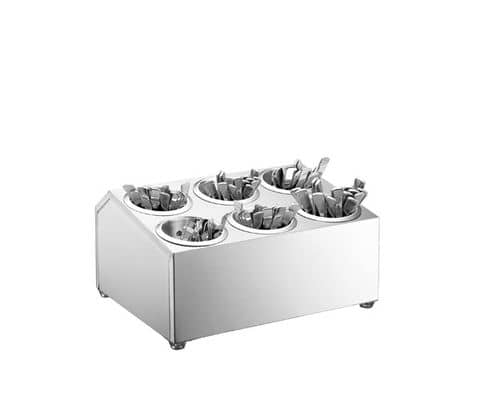
In a cafeteria, the serving process often begins even before the actual meal selection. Plate dispensers, serving trays, cutlery holders, and other components are therefore functional parts of the self-service line. Plate dispensers provide plates at the designated entry point or at the appropriate station. Trays must also be available where guests need them, without causing a backup at the start of the line. Depending on the layout, cutlery can be placed at the beginning or end of the line. What matters most is not a universal order but the actual flow of guests. Anything guests have to look for or go back to get creates additional movement and can reduce throughput. A clearly laid-out serving line, on the other hand, makes it easier even for new or first-time guests to find their way around.
Design built-in counters based on the dining concept
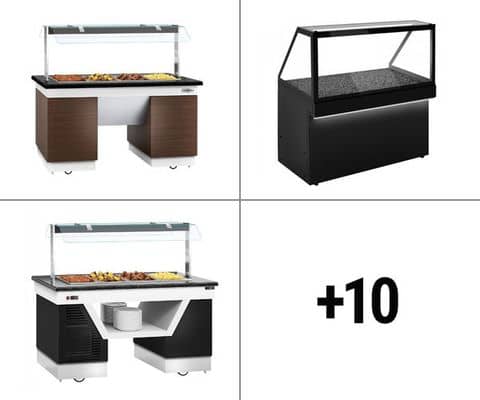
Built-in counters make it possible to combine different functional modules within a cafeteria service area. Depending on the menu offerings, hot, refrigerated, or ambient-temperature sections may be required. This allows the service area to be better tailored to the specific menu and the available space. When planning, both the display area and accessibility from the staff side are important. It must be possible to refill containers and clean work areas without unnecessarily interrupting the flow of guests. The number of dishes presented simultaneously also influences the required length. A wider selection not only makes the offering more appealing but also requires more containers, more restocking, and may result in longer decision-making times. The menu selection and serving capacity should therefore be well-matched.
Multiple stations can help spread out the flow of guests
Not every cafeteria needs to be set up as a single long serving line. When there are large numbers of visitors, it can make sense to have separate areas for main courses, salads, desserts, or beverages, for example. This helps spread guests out more throughout the space. It is crucial, however, that the pathways remain easy to follow. Too many individual stations can also lead to unnecessary crisscrossing. The layout should therefore be designed with typical guest flow in mind: entering, picking up a tray or plate, selecting food, adding drinks, paying, and then reaching the seating area. A well-organized serving area not only reduces wait times; it also makes it easier for staff to restock, since not every trip requires passing through the middle of the same line.
Use tray and transport carts for larger quantities
In cafeterias, large quantities of trays, containers, and tableware are moved between different areas. Tray & Transport Carts can facilitate these internal transport routes. They are suitable, for example, for transport between the kitchen and the serving area, for prepared trays, or for return trips, depending on the specific model and operational concept. The importance of suitable transport equipment becomes particularly clear when distances are longer. Many individual manual transport trips tie up staff and increase the number of trips. A cart can move larger quantities all at once. However, carts themselves require sufficient space to maneuver and park. Passageways, doors, and handoff points should therefore be planned so that loaded carts can be used without blocking central work areas.
Using GN containers as a common process language
Standardized container sizes facilitate the transfer of food between preparation, production, storage, transport, and serving in institutional food service. GN containers can be used at different stations depending on the process, thereby reducing unnecessary transfer between containers. This also simplifies quantity planning. Once it is clear how many servings a particular container holds on average, production batches, hot-holding reserves, and restocking schedules can be better coordinated. Lids, container depths, and the required quantities should also be tailored to the meal plan. A standardized container system may seem like a minor detail at first, but it can make many handoffs in daily cafeteria operations significantly more structured.
Using Stainless Steel Furniture in High-Traffic Production Areas
Stainless steel furniture provides work, shelving, and storage space in many cafeteria kitchens. Especially when handling large volumes of food, sufficient space is needed to set out GN containers, baking sheets, ingredients, and utensils between individual steps. Insufficient counter space quickly leads to appliance surfaces or transport carts being used as makeshift storage areas. Base cabinets can also help keep frequently used equipment readily available at individual workstations. However, it is crucial not to overcrowd the kitchen with furniture. Sufficient space for movement and transport must remain between cooking kettles, tilting frying pans, combi steamers, and work tables. Especially when using carts or larger containers, wider aisles are often more important for operations than an additional table.
Planning the Return of Dishware from the Guest to the Dishwashing Line
After the meal, a second large-scale process begins. Trays, plates, cutlery, glasses, and food scraps are returned from the dining area within a short time. If this return process is poorly organized, it can overload the entire dishwashing area. A clearly marked return station helps guests place used tableware in an orderly manner or hand it over to the designated process. From there, food scraps must be removed, tableware sorted, and the various items routed to the appropriate dishwashing equipment. It is important that the return and serving areas do not intersect as much as possible. Guests carrying used trays should not have to walk through the area where fresh food is being served at the same time. This separation promotes both hygiene and a smoother flow of guests.
Sizing Conveyor-Type Dishwashers for Large Volumes of Dishes
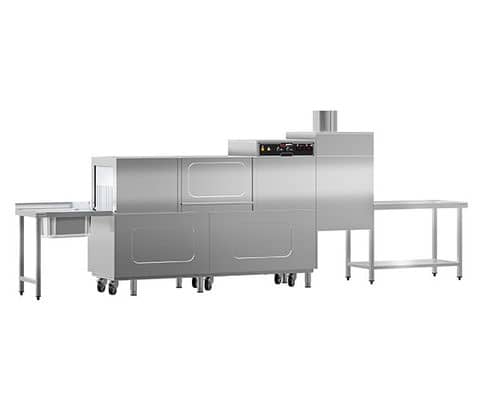
When serving large numbers of meals, dishwashing technology is one of the most critical factors affecting a cafeteria’s capacity. Conveyor-belt dishwashers are designed for continuous dish throughput and can be particularly useful in settings where large quantities of plates and other dishes return within a short period of time. The required capacity should match the peak volume of dish return. It’s not just the machine itself that matters. Pre-sorting, clearing areas, and the provision of clean dishes must all support the same throughput. A high-capacity dishwasher is of little use if trays and plates pile up in front of it because there isn’t enough space for preparation. Similarly, clean dishes need a clear path back to the serving area or storage after the wash cycle.
Tray washers and cutlery processing as separate subprocesses
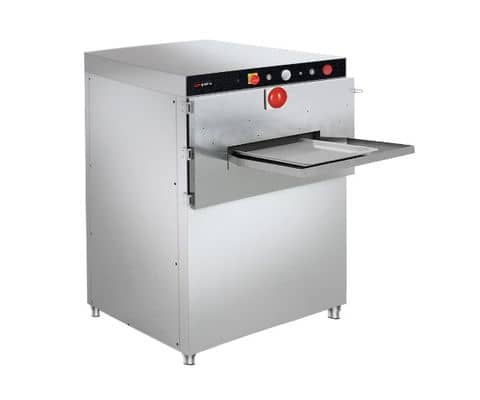
Because of their size, trays have different requirements for the dishwashing process than plates or cutlery. Tray washers can therefore provide a dedicated solution for this type of returnware when dealing with sufficient volumes. Cutlery also generates high volumes. Depending on the operation, cutlery polishing machines can supplement the preparation process after washing. These processes demonstrate why dishwashing in a cafeteria should not be viewed as a single machine operation. The entire cycle includes collection, sorting, washing, polishing (if necessary), storage, and restocking. The better this return process is coordinated with service, the smaller the reserve stock of tableware needs to be to maintain operations throughout an entire meal period.
Incorporate waste and food scraps into the feedback loop
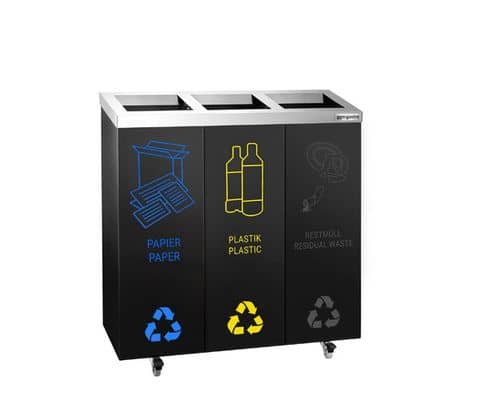
When several hundred or thousands of meals are served, corresponding amounts of food scraps and waste are generated. These should not be considered only as an afterthought in the planning process. Waste bin coolers and solutions for food scrap disposal can be part of an organized waste disposal area, depending on the facility. It is crucial to have a short, clear path from the dish return area to waste disposal, without having to move waste through clean production or serving zones. Container sizes and emptying intervals should also be based on the actual volume of waste. A well-organized waste disposal system keeps return and washing areas more orderly and prevents full containers from becoming bottlenecks during peak hours.
Organizing the Cleaning of Larger Areas Cost-Effectively
Cafeterias often include not only a large kitchen but also extensive serving areas, dining rooms, and circulation areas. Cleaning these areas is therefore a significant operational process. Scrubber-dryers can help systematically clean larger floor areas on suitable surfaces. Sanitary facilities and waste management systems round out the operational equipment outside the actual kitchen. Here, too, the actual size and usage are decisive factors. A small company cafeteria has different requirements than a large dining hall with several hundred seats. Cleaning technology is particularly cost-effective in settings where repetitive manual labor on larger, freely accessible areas can be reduced.
Planning Cafeteria Equipment Based on Staff Structure
Large production volumes do not automatically mean that every step in the process requires more staff. A well-designed cafeteria uses technology and workplace organization to keep recurring processes manageable. Standardized containers, clear production batches, defined serving stations, and a structured dish return system also make training easier. Equipment should, whenever possible, be used in a way that ensures workflows remain reproducible and do not depend solely on the experiential knowledge of individual employees. Especially when staff rotates or employees are absent due to illness, it becomes clear how important clearly defined stations and transparent processes are. The equipment thus supports not only performance but also organizational stability.
Prioritizing Cafeteria Equipment Based on Cost-Effectiveness
When opening a new facility, priority should first be given to the areas that support day-to-day operations. These include adequate refrigeration and storage, efficient food preparation and cooking equipment, food holding systems, a suitable serving line, and sufficient dishwashing capacity. Specialized equipment makes sense where certain work steps regularly generate high volumes or require a significant amount of staff time. Even for an existing cafeteria, it’s worth starting with a bottleneck analysis. Long lines can result from a serving station that’s too small, but also from slow restocking or an inefficient menu structure. Production problems can arise from insufficient cooking capacity—or from a lack of prep and refrigeration space. Backups in the dining hall, in turn, may be due to a dishwashing or return station that is too small. The economically sound investment starts where the entire process chain is actually constrained.
Equip Your Cafeteria Professionally with GGM Gastro
From small company cafeterias to university dining halls or larger institutional food service operations, the number of daily meals, menus, and serving methods vary considerably. The right cafeteria equipment is therefore selected based on portion sizes, production models, peak times, self-service structures, and dish return systems. GGM Gastro offers a full range of equipment for these needs, from combi steamers, cooking kettles, and tilting fryers to cold storage rooms, stainless steel furniture, and thermal carts, as well as self-service systems, plate dispensers, transport carts, conveyor belt systems, and tray washers. This allows for the customization of entire areas in a new facility, as well as individual production, serving, or dishwashing stations during modernization and capacity expansion, to meet specific needs.