


Saladettes
Saladettes are refrigerated preparation stations for salads, toppings, sauces, and fresh ingredients in professional food service establishments. They combine refrigeration, a work surface, and direct access to GN containers, helping to streamline operations in kitchens, snack bars, bistros, or pizzerias. Saladetten Guide »





Saladetten: A Refrigerated Workstation for Everyday Use in the Food Service Industry
Saladettes are refrigerated units designed for the professional preparation and temporary storage of fresh ingredients. They are used when vegetables, salads, sauces, cheese, cold cuts, toppings, or prepared ingredients need to be refrigerated, organized, and readily accessible right at the workstation.
In restaurants, snack bars, bistros, cafés, pizzerias, snack concepts, and catering services, saladettes play a clear role in day-to-day operations: They shorten walking distances, bring order to the mise en place, and help keep ingredients within easy reach during preparation. What matters most is not just the refrigeration itself, but the combination of work surface, GN tray holders, interior space, and a suitable cover. Especially during peak hours, a well-placed saladette can prevent staff from having to constantly switch between the main refrigeration area, the prep station, and the serving area.
Which Saladette is right for your business?
The right saladette depends on the type of establishment, available space, and workflow. In small snack bars or eateries, compact models with a narrow width are ideal when space is limited but multiple ingredients still need to be readily available right at the station. In pizzerias, bistros, or restaurants with higher throughput, wider saladettes with two or three doors are often used to provide more refrigeration capacity and more GN container slots.
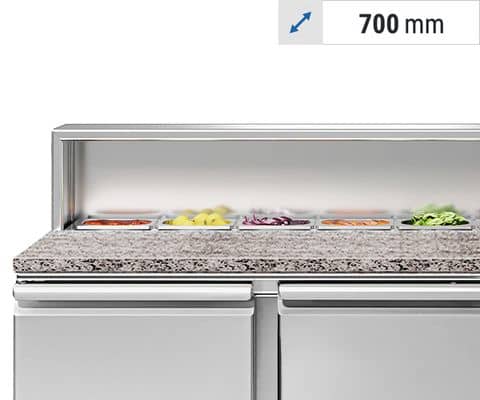
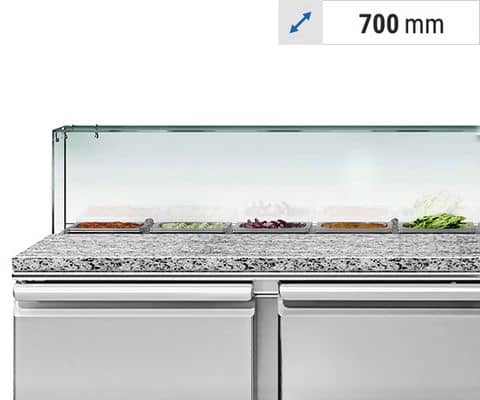
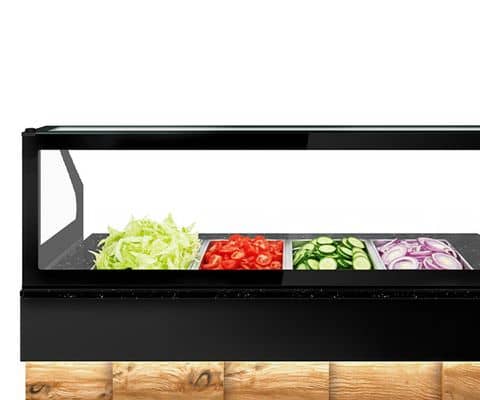
Key decision-making criteria include dimensions, GN compartment layout, number of doors, temperature range, work surface, and type of cover. Models with glass tops provide a clear view of the ingredients and protect the open area. Variants with stainless steel lids appear more enclosed and robust and are particularly suitable for work areas where ingredients do not need to be permanently on display. A model with a cutting board or sturdy work surface facilitates direct portioning, topping, and plating.
Anyone who regularly prepares pizza, bowls, sandwiches, or salads should not view the saladette in isolation, but rather as part of the prep line. The better the cooling, access, and work surface are coordinated, the more smoothly the station will operate.
Planning, Space Requirements, and Integration into the Work Process
A saladette should be placed where it is actually needed in the workflow. For efficient operation, it is crucial that ingredients are available right before they are used, cut, or plated. If the saladette is placed too far from the serving area or main work surface, it creates unnecessary walking distances. If it’s too small, containers must be refilled more frequently, or ingredients end up in makeshift storage solutions.
During the preparation phase, a saladette facilitates clear portioning and sorting. During service, it ensures quick access to frequently used ingredients. When guest volume is high—such as during lunch service or dinner service—it’s especially important that containers are arranged logically and that the work surface isn’t overloaded.
For cohesive planning, it’s worth considering adjacent work areas. Saladettes can be effectively combined with prep tables, refrigerated tables, stainless steel furniture or pizza refrigerated counters when multiple production steps need to flow smoothly into one another. It’s important to distinguish: A saladette is neither a simple storage cooler nor a display case, but rather a refrigerated workstation for food preparation.
Quick Checklist for Choosing Your Saladette
-
Does the width fit the available counter space and workflow paths?
-
Is the GN compartment layout sufficient for the ingredients used daily?
-
Is a glass lid or a closed stainless steel lid required?
-
Is the interior configured with doors, racks, or drawers to suit the workflow?
-
Is a 230-V outlet available at the planned location?
Materials, Hygiene, and Durability in Daily Use
In commercial settings, salad bars are frequently opened, filled, cleaned, and used in direct contact with food. That is why stainless steel, smooth surfaces, easily accessible interiors, and sturdy construction play a key role. Moisture, cleaning agents, temperature fluctuations, and mechanical stress are part of everyday use. A hygienic design facilitates cleaning and reduces unnecessary time spent on cleaning at the end of the shift.
Temperature control should also be appropriate for the application. Many saladettes operate within temperature ranges suitable for fresh ingredients, sauces, or prepared components. It is important to follow the manufacturer’s specifications regarding the temperature range, ambient temperature, and loading capacity. Hot foods or ingredients that have not been pre-chilled should not be left in a saladette for extended periods, as this can compromise cooling performance and product safety.
Economic Benefits Through Clear Processes
A well-designed saladette is no substitute for good kitchen planning, but it can make an important contribution to process stability. When ingredients are organized, chilled, and readily available at the workstation, the time spent searching for them is reduced. Work routes become shorter, restocking processes more predictable, and repetitive tasks easier. This is particularly helpful for establishments with rotating staff, high-volume operations, or limited space.
A saladette makes economic sense above all when it resolves a real bottleneck in daily operations: long distances to refrigeration, disorganized ingredient storage, slow assembly, lack of counter space, or frequent rearranging during peak hours. The purchase should therefore always be tailored to the menu, expected throughput, and existing kitchen layout.
Choose Saladetten at GGM Gastro
At GGM Gastro, establishments can find salad stations for a variety of applications—from compact models for small kitchens to larger ones for busier prep areas. It’s crucial to base your selection not only on price or external dimensions, but on the actual workflow: What ingredients are used daily? How many containers need to be accessible at the same time? How much counter space is needed? And how heavily is the station utilized during peak hours?
This makes the saladette a functional component of the operation: It promotes freshness, organization, hygiene, and speed in areas where food preparation and service must work closely together.