


Filling Machines for Liquids and Pastes
Filling machines help commercial businesses accurately portion liquids, creams, oils, and pastes. Depending on the workflow, manual and pneumatic solutions are available for fill volumes ranging from 5 to 50 ml. Filling Machine Guide »
Price
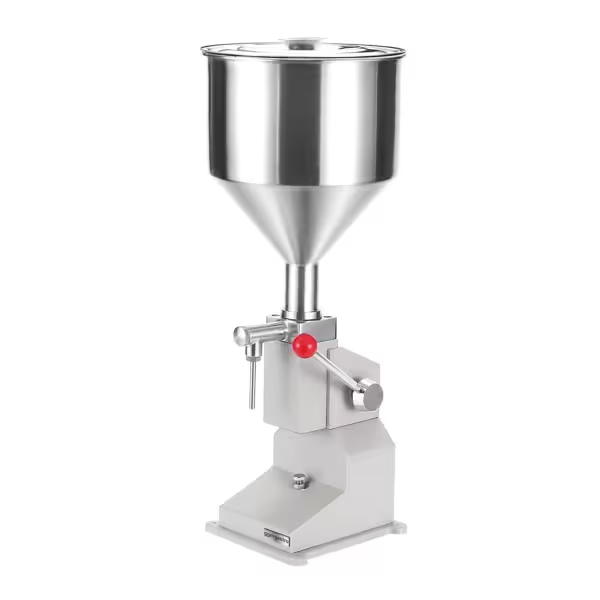
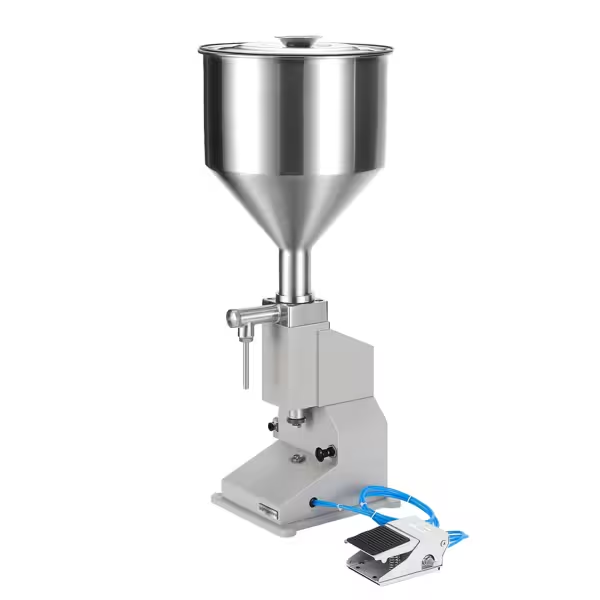
Filling Machines for Controlled Portioning in Food Service Operations
Filling machines dispense liquids and pasty products in consistent quantities into appropriate containers. In the restaurant industry, catering, and commercial food processing, they are particularly useful when creams, oils, or pastes need to be portioned regularly and the filling process needs to be organized in a way that is faster, cleaner, and more reproducible.
The workflow depends not only on the machine and the fill volume, but also on the location. The filling machine requires a stable, easily accessible work surface as well as sufficient space for storage containers, target containers, and cleaning after use. The 10-liter hopper on the models offered creates a defined product supply directly at the station. In small prep kitchens, a dedicated filling station reduces unnecessary back-and-forth between storage, portioning, and further processing; in production kitchens, this step can be clearly positioned between preparation and downstream packaging.
Manual or pneumatic—to suit your own work pace
The most important factor in selecting a machine is the operating mode. The manual filling machine operates without an external compressor and is therefore suitable for businesses seeking a simple solution for manageable batches or varying applications. The pneumatic version is activated via a foot pedal. This keeps the operation clearly structured during repetitive filling processes, while leaving the hands free to guide containers and change products.
An external compressor is required for pneumatic operation. The specified operating pressure ranges from 0.4 to 0.6 MPa. This factor must therefore be considered early in the layout and technical planning: the compressed air supply, floor space, and working position must all be compatible. Both versions are designed for the same filling range of 5 to 50 ml, but differ significantly in how the filling process is integrated into daily operations.
Correctly classify fill volume, opening, and accuracy
For filling machines, the combination of product, portion size, and target container is key. The adjustable range of 5 to 50 ml is designed for small, clearly defined portions. The 4- and 8-mm filling openings provide additional flexibility for adapting to different consistencies and container openings.
Filling accuracy of ±1% is also a key selection criterion when portions need to be as uniform as possible. In operation, this can support cost calculation and standardization because dosing is less reliant on guesswork. At the same time, the consistency of the product remains important: thin liquids behave differently than thicker pastes. The machine, opening, and fill volume must therefore be considered as a single unit.
Hygiene and Integration in the Workplace
Filling processes are an integral part of food processing. Parts that come into contact with the product and work surfaces must therefore be incorporated into the cleaning routine in such a way that residues can be removed in a controlled manner between batches or product changes. When selecting materials, consider suitable, easy-to-maintain surfaces and easily accessible areas; the specific material configuration depends on the respective model.
A clearly defined space on easy-to-clean stainless steel furniture facilitates organization and prevents filling, storage, and cleaning from all taking place on the same unplanned surface. For ingredients that require refrigeration, sourcing them from nearby refrigerated counters can shorten distances and support process management. If filled containers are subsequently sealed, suitable sealing machines can be incorporated as a downstream step. The filling machine remains clearly responsible for dosing and filling and does not replace an industrial filling, capping, or packaging line.
Quick Checklist for Selection
- Filling range: Does 5 to 50 ml fit the intended portion size?
- Product: Is it a suitable liquid, cream, oil, or paste?
- Operation: Is a manual solution sufficient, or does pneumatic activation better suit the process?
- Infrastructure: For the pneumatic version, is a compressor capable of 0.4 to 0.6 MPa available?
- Workstation: Are the funnel, target container, cleaning station, and post-processing area arranged in a practical manner?
Filling Machines as a Cost-Effective Process Component
A properly selected filling machine can standardize repetitive portioning tasks and thus make teamwork more organized. The economic benefit stems less from cutting-edge technology than from seamless integration: appropriate fill volumes, short travel distances, controlled cleaning, and an operating mode that matches the actual production volume.
For smaller operations, a manual solution may be sufficient, while regular filling operations may make the use of a pneumatic model advisable. The key factor remains actual usage in the operation. In this way, the filling machine does not become an isolated piece of equipment, but rather a clearly defined step within a stable preparation and processing workflow.