


Butcher Shop Equipment for Professional Businesses
From refrigerated storage to cutting and processing to presentation at the sales counter: Well-designed butcher shop equipment combines machines, work surfaces, and refrigeration technology to create a safe and efficient production process. The equipment needed depends primarily on the product range, processing volume, in-house production, and available space. Butcher Shop Equipment Guide »
Production











Other Equipment









Setting Up a Butcher Shop: Planning Equipment Along the Flow of Goods
Professional butcher shop equipment includes the technology and work areas needed for storing, cutting, processing, portioning, packaging, displaying, and cleaning meat and sausage products. Depending on the business model, the focus can vary significantly. A butcher shop with extensive in-house sausage production requires different capacities than a business that primarily cuts, portions, and sells over the counter. In addition, there are concepts that include catering services, delicatessen items, or additional convenience products. The flow of goods is therefore crucial for planning: Raw materials arrive at the facility refrigerated, are prepared and processed, portioned or packaged as needed, and then either stored refrigerated again or made ready for sale. The more clearly these work steps are coordinated spatially and technically, the fewer unnecessary transports, temporary storage operations, and rearrangement tasks will occur.
Select the appropriate meat grinder, cutter, and meat mixer for your production needs
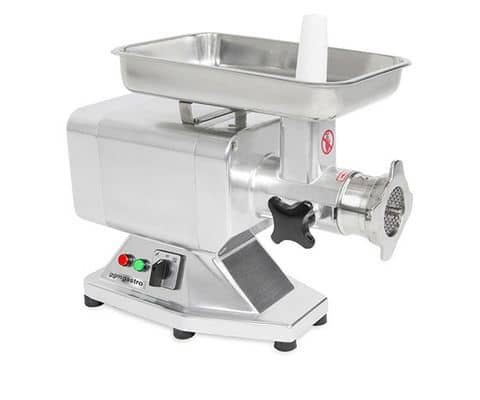
In facilities with their own processing operations, meat grinders are often among the key pieces of equipment. They facilitate the production of ground meat, fillings, and other processed meat products. The appropriate size and capacity depend primarily on the quantities processed within a given production window. For finer or more finely chopped product masses, cutters are also used. Meat mixers, in turn, are used when larger quantities need to be evenly blended with spices or other ingredients. The key is the coordination of these machines. For example, if large quantities can be ground but the subsequent mixing process has significantly less capacity, this simply creates a new bottleneck. The required workspace is also part of this production chain. Raw materials, containers, and finished batches need clearly defined transfer points. Machine performance and workplace organization must therefore be considered together.
Organizing Sausage Production as a Coherent Process
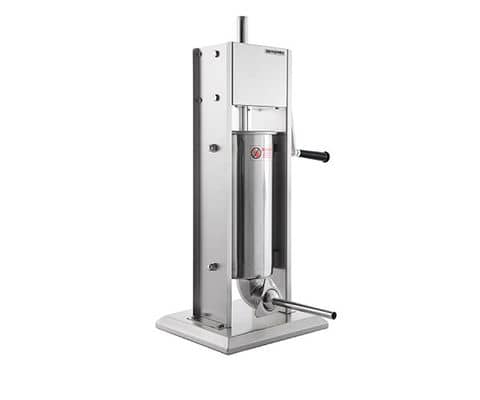
When producing your own sausage, the production line is expanded to include additional steps. After grinding and mixing, the product is either filled into casings or portioned, depending on the product. Sausage filling machines support this process and are available in various models to accommodate different production volumes. Here, too, the key factor is not so much the maximum capacity as it is a performance level that matches the meat grinder, cutter, or mixer and the actual production volume. A smaller artisanal operation with manageable batches requires different equipment than a butcher shop that produces large, standardized quantities daily. Containers, work surfaces, meat hooks, and temporary storage must also fit into the workflow. The less a batch needs to be moved between individual processing steps or transported over long distances, the more smoothly production can be organized.
Cutting, Portioning, and Slicing with the Right Workstations
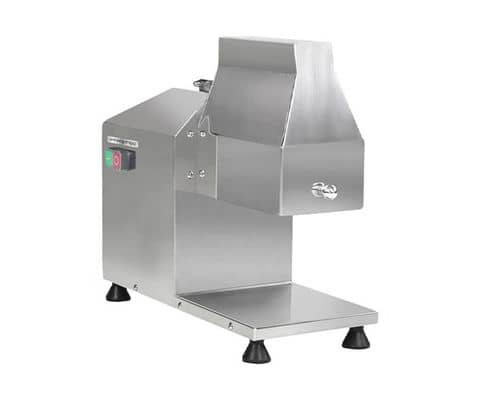
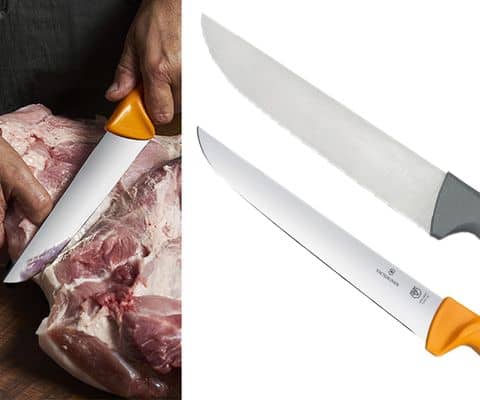
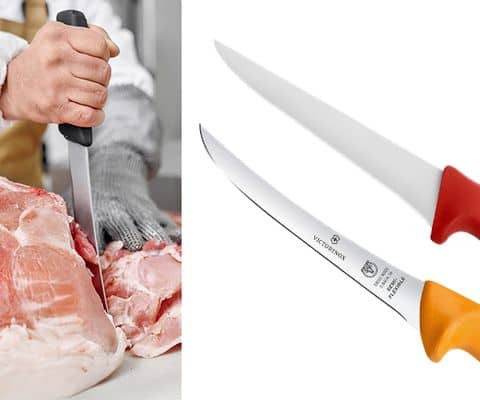
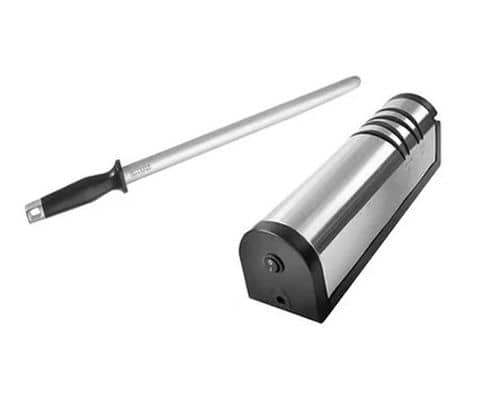
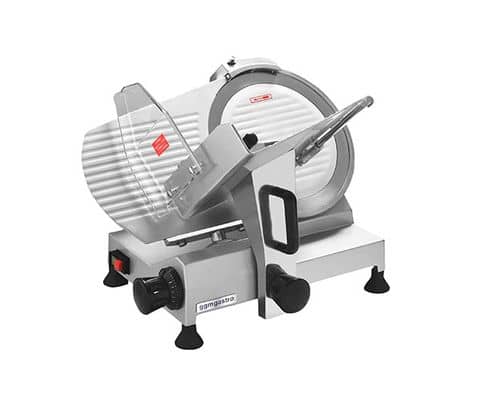
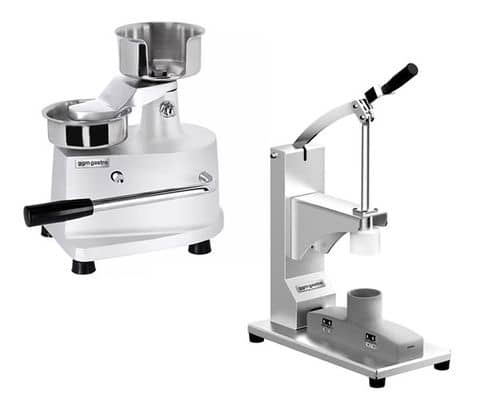
Not all meat processing starts with the meat grinder. A significant portion of the daily work involves cutting up, trimming, and portioning. Bone saws are useful in situations where bone-in cuts of meat are regularly processed. In addition to cutting performance, other factors important for the workplace include floor space, safe operation, ease of cleaning, and an efficient flow of materials before and after cutting. Meat tenderizers, steak cutters, and tenderizing hammers handle additional processing steps depending on the product line. Slicers are used to ensure uniform slices of sausage, ham, or cold cuts. Hand tools also remain essential. Meat, butchering, cutting, and filleting knives perform various tasks during processing. Knife sharpeners and knife sterilizers can complement the organization of this work area.
Butcher’s tables and chopping blocks provide dedicated workstations for these tasks. A clear division of tasks is particularly worthwhile for frequently recurring activities: cutting, portioning, and packaging each require sufficient space, ensuring that different work processes do not constantly occupy the same workstation.
Quick Checklist for Choosing the Right Butcher Shop Equipment
Five points can help you assess your actual needs:
- Production program: Which meat and sausage products are processed or manufactured in-house?
- Batch size: What quantities must be handled within a typical production window?
- Processing steps: Does the process involve cutting, sawing, grinding, mixing, stuffing, slicing, or vacuum-sealing?
- Refrigeration infrastructure: What capacity is required for raw materials, temporary storage, and ready-to-sell products?
- Sales Model: Are sales primarily conducted via a service counter, pre-orders, packaged goods, or additional sales channels?
Based on these points, it is possible to determine which machines form the core of production and which equipment is needed only for specific product lines.
Think about cooling from the time goods arrive until they reach the sales counter
In a butcher shop, refrigeration isn’t just a single piece of equipment—it’s part of the overall flow of goods. Raw ingredients, intermediate products, and ready-to-sell goods all require sufficient capacity at the appropriate locations. Cold storage rooms & refrigeration units can accommodate larger quantities of goods and reserves. However, the distance between storage and processing is also a critical factor. If employees have to travel long distances for each batch, this creates additional daily movement between the refrigerated area and production. After processing, the goods are once again stored in a refrigerated intermediate or sales storage area. The available capacity must therefore not only accommodate the entire inventory but also align with the production cycle and restocking logic. Dry aging can play a special role. If aged meat is part of the product lineup, a separate, controlled area is created for this purpose. Accordingly, this technique is not a standard feature of every butcher shop, but rather a targeted addition to a suitable product concept.
Meat display cases combine storage, presentation, and sales
The sales counter is where production and the customer come together. Meat display cases showcase meat and sausage products and keep the items intended for sale chilled and ready for purchase. When selecting a counter, the available floor space is important, but the required presentation and display capacity is even more critical. A wide product range requires more space, but it also involves more effort when it comes to stocking, restocking, and daily merchandise organization. The counter is not an isolated sales area. Behind it, scales, packaging materials, knives, cutting surfaces, and frequently requested items must be organized in such a way that orders can be prepared without unnecessary trips. The quality of this layout becomes particularly evident during peak hours. If two employees constantly have to cross paths or make multiple trips to the back refrigerated areas for standard items, the sales process slows down.
Slicing and Portioning for Consistent Sales Volumes
Many products sold at a butcher shop are shaped into their desired form only immediately before sale. Slicing machines help ensure consistent processing of sausage, ham, meat, or other suitable products. For frequent use, factors such as blade diameter, cutting area, ease of operation, and required floor space are important. For businesses with high slicing volumes, more powerful or automated models may be worth considering, while a more compact solution may suffice for smaller quantities. Integration into the workspace is also important here. The machine requires sufficient space for the raw product, the sliced goods, and subsequent packaging. The fewer intermediate steps required between slicing, weighing, and packaging, the more efficiently a higher customer volume can be handled.
Integrating Vacuum Sealing and Packaging into the Production Workflow
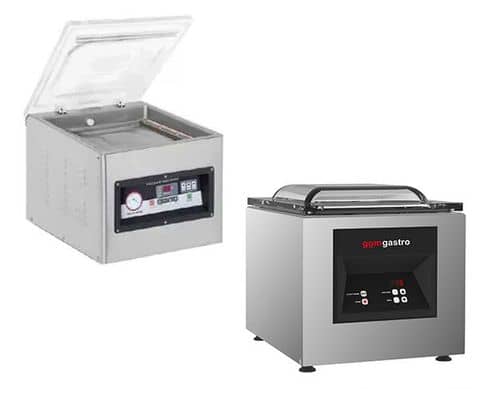
Vacuum sealers can perform various tasks in butcher shops: packaging prepared goods, organizing products for storage or further processing, or creating units ready for sale. The key factor is the packaging station’s position within the flow of goods. A machine that is used intensively every day requires a dedicated work surface as well as sufficient space for bags, containers, labeling, and finished goods. Sealing machines can also be used to complement specific packaging concepts. The same principle applies to packaging: Additional equipment makes sense only if it supports regularly used processes. An extensive machine fleet is of little use if the equipment is rarely used while simultaneously taking up valuable production space.
Hygiene starts with material flow and work surfaces
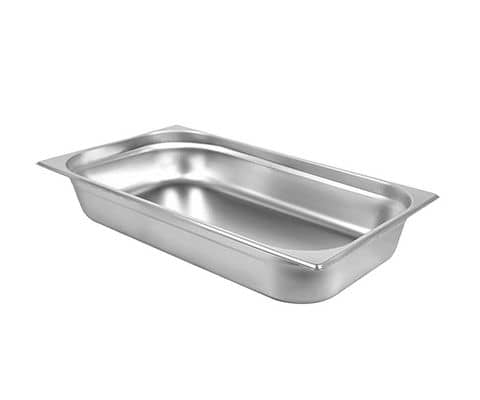
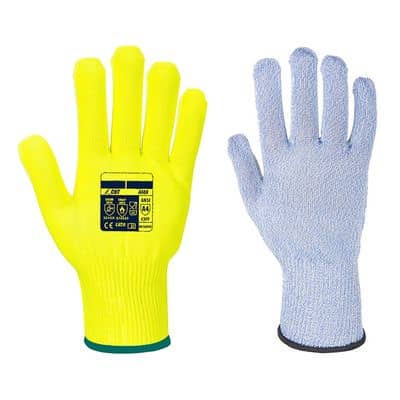
In meat processing, the layout of the workspace directly affects how easily hygienic procedures can be implemented in day-to-day operations. Raw materials, processed products, packaging materials, and equipment in use require clearly organized areas. Smooth, easily accessible work surfaces facilitate regular cleaning and reduce areas where production residues can accumulate. Stainless steel is therefore a practical choice of material for many meat-processing tables and workstation furniture. Chopping blocks and specialized work surfaces complement the equipment where the specific processing requirements call for them. Knives and tools also require designated storage locations. The more clearly work tools are stored, cleaned, and returned to their proper places, the less need there is for improvisation during production. Cut-resistant gloves and other personal protective equipment play a particularly important role in maintaining a professionally organized workplace, especially at cutting and butchering stations.
Schedule cleaning as a separate process step
After intensive meat processing, machines, containers, work surfaces, and floors must be able to be cleaned thoroughly. This requires not only cleaning agents, but above all, accessible equipment and sufficient space to move around. Meat grinders, cutters, bone saws, and sausage fillers differ significantly in their design and the effort required to clean them. When selecting equipment, it is therefore important to consider how easily areas that come into contact with the product can be accessed and prepared for cleaning. Hose reels, cleaning stations, and rinsing equipment can also be part of a well-thought-out cleaning plan. The time required for these tasks is a factor in the equipment’s cost-effectiveness. A piece of equipment may be technically capable but still result in additional daily labor if cleaning and reassembly are unnecessarily complicated. Waste disposal also requires a set procedure. Production residues and waste should not block normal workflows or goods routes. Waste coolers can support a separate, refrigerated disposal area if needed.
Plan capacity based on production rather than just retail space
The size of a butcher shop alone says little about the machine capacity required. Two stores of similar size can have completely different production volumes. A butcher shop with extensive in-house production may process large batches in the morning and then sell them throughout the day. Another business relies more heavily on purchased products and therefore requires less processing equipment, but more display and storage capacity. That’s why it’s important to evaluate each main machine based on its actual use: How many kilograms or batches are processed? How long is the equipment in operation per production day? Which machine follows in the next step of the process? And is its capacity also sufficient? This approach avoids creating a collection of individual machines with the highest possible performance and instead results in a production line whose components are designed to work together seamlessly.
Prioritizing Butcher Shop Equipment Based on Cost-Effectiveness
When opening a new facility or modernizing an existing one, priority is first given to the areas that support core daily operations. For a business with its own ground meat and sausage production, these might include, for example, refrigeration, meat grinders, processing tables, cutters or mixers, and sausage fillers. A butcher shop focused on sales and cutting may place greater emphasis on the refrigerated display case, slicer, cutting area, and packaging. Specialized equipment is then added where it supports a regularly relevant product range. Even for existing businesses, a bottleneck analysis is helpful before making an investment. If production takes too long, a larger machine isn’t necessarily required. Perhaps goods have to be moved multiple times between two work steps, the refrigeration unit is too far away, or the packaging station is holding up the flow of goods. The economically sound investment addresses precisely these kinds of recurring bottlenecks.
Professional Butcher Shop Equipment from GGM Gastro
Whether it’s an artisanal butcher shop with its own sausage production, a butcher shop with an extensive selection of fresh meats, or a business offering additional packaged products: The right equipment depends on the product line, processing volume, refrigeration needs, sales format, and available space. GGM Gastro offers catering equipment ranging from meat grinders, cutters, sausage fillers, and bone saws to butcher’s tables and slicers, as well as meat display cases, vacuum packaging equipment, and cold storage rooms. This allows you to configure both complete work areas for new openings and individual production, refrigeration, or sales stations for modernization and expansion projects, tailored to your specific needs.