


Honey Extractors for Professional Honey Processing
Electric honey extractors extract honey in a controlled manner from uncapped combs and facilitate a quick, clean workflow during honey harvesting. Compact stainless steel models are particularly well-suited for commercial apiaries, direct sellers, and processing facilities with manageable batches. Guide to Honey Extractors »
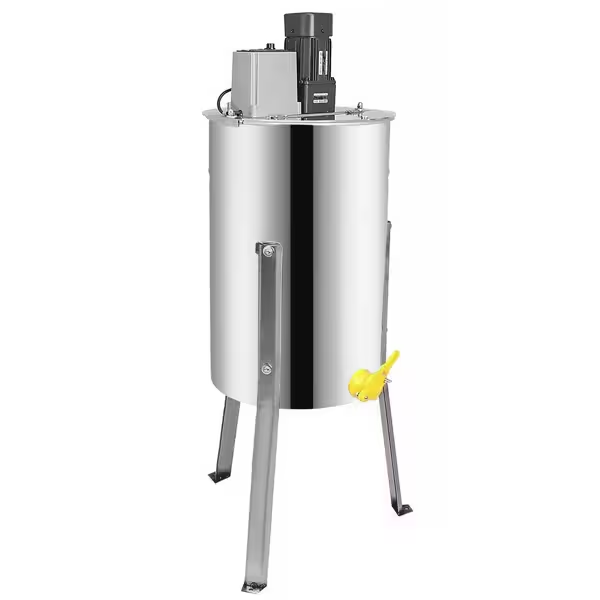
Honey Extractors as a Compact Solution for Honey Extraction
Honey extractors use centrifugal force to extract honey from uncapped combs without putting unnecessary strain on the comb structure. Electric models reduce the amount of manual effort required and make the extraction process easier to control.
In day-to-day work, the main benefit lies in a clear sequence of steps: uncapping the combs, loading them properly, gradually increasing the centrifuge speed in a controlled manner, allowing the honey to drain, and preparing the next frames. With three loading slots, the process remains straightforward; at the same time, it’s important to load the extractor as evenly as possible to ensure it runs smoothly. Especially during seasonal peaks in workload, a fixed routine helps avoid searching for items and unnecessary interruptions between batches.
For smaller commercial apiaries, farm stands with their own production, or artisanal honey producers, the most important factor is that the extractor matches the actual harvest volume. The models in this category are designed for three frames and combine a compact design with an electric drive. This is particularly useful when processing smaller batches on a regular basis and a manageable workspace is more important than maximum capacity.
Select the capacity and frame size that are appropriate for your operation
With a honey extractor, it’s not just the number of frames that determines the workflow. It’s equally important that the frame size used fits the extractor. The models offered are designed for frames up to 235 × 44 × 488 mm. Before purchasing, it is therefore worth checking directly to ensure compatibility with the comb dimensions used in your operation.
Three frames per spinning cycle allow for clearly planned batches. For small harvest quantities, this capacity can fit well into a compact process consisting of uncapping, spinning, collecting, and further processing. For significantly larger daily quantities, however, the number of spins required becomes a decisive economic factor.
Electric drive for smooth operation
The 140-watt electric motor offers various speed settings and reaches up to 280 revolutions per minute. This allows the spinning process to be adapted to the workflow without having to crank it manually the entire time. A 230-V connection makes it easy to integrate the unit into many commercial work environments.
The external dimensions of 380 × 380 × 605 mm are important for installation. In addition to the footprint, there should be sufficient space for loading, unloading the frames, and cleaning. Height-adjustable feet help ensure the unit is properly leveled; the work surface should be level and suitable for food processing.
Stainless steel, cleaning, and a clean honey outlet
In honey processing, the focus is on hygienic surfaces and easily accessible areas. The extractors are made of AISI 201 stainless steel. Two Plexiglas lids allow the process to be observed, while a honey shut-off valve ensures controlled drainage into a suitable container.
For cleaning, it is crucial to remove honey residue promptly and keep surfaces that come into contact with the product easily accessible. A clear space around the unit and the outlet makes it easier to wipe down the machine, remove containers, and inspect the equipment after spinning. This ensures that the honey extractor not only stays clean but is also quickly ready for the next use.
A practical work area connects the honey extractor to an easy-to-clean surface made of stainless steel furniture and short distances to sinks & cleaning stations. This allows frames, collection containers, and work tools to be handled in an organized manner without cluttering the extractor area with unnecessary back-and-forth movement. For subsequent processing, the process can be continued toward filling machines if the operational model is suitable.
Quick Checklist for Choosing a Honey Extractor
Before placing an order, consider these five points to help you make the right choice:
- Does the frame size you’re using fit within the dimensions of up to 235 × 44 × 488 mm?
- Is a capacity of three frames sufficient for your planned batches?
- Is a 230-V outlet available at the intended workstation?
- Has space of 380 × 380 × 605 mm, plus room for operation and cleaning, been planned for?
- Does an electric drive with up to 280 rpm fit your desired work rhythm?
Plan for economic efficiency rather than just comparing performance
The right honey extractor ensures a smooth, consistent process because its capacity, frame size, footprint, and drive system are all designed to work together. This can reduce unnecessary manual labor and make it easier to plan the processing of smaller batches.
Therefore, the purchase price alone is not the only factor in the investment decision. What matters most is whether the extractor is suited to the harvest volume, the available space, and the actual workflow. A compact unit can make economic sense if it is used regularly, remains easily accessible, and can be integrated into cleaning and further processing without any additional steps.