


Fried & Grilled Chicken Equipment for Professional Food Service
From marinating and breading to deep-frying or grilling, all the way to keeping food warm and serving it quickly: Professional fried and grilled chicken equipment combines specialized poultry preparation with high production capacity. Which equipment is right for you depends primarily on your menu selection, volume, preparation method, sales format, and peak order times. Fried & Grilled Chicken Guide »
Especially for Chicken





















Setting Up a Fried-and-Grilled Chicken Concept: From Product to Production Line
Professional Fried & Grilled Chicken Equipment includes appliances and workstations for refrigerated preparation, marinating, breading, deep-frying or grilling, holding warm, portioning, and serving poultry products. The production processes differ significantly. Fried chicken typically requires a structured process consisting of preparation, seasoning or marinating, breading, frying, and then serving or holding warm for a limited period of time. With grilled chicken, on the other hand, the focus is on preparation, seasoning or marinating, and controlled production in the chicken grill. Establishments that offer both product groups should not simply mix these processes on a shared work surface. It makes more sense to establish a clear kitchen layout with shared areas for storage and preparation, as well as separate stations for breading, deep-frying, and grilling. This creates a production system that remains organized even during periods of high order volume.
Clearly separate poultry preparation from the finished product
Raw poultry requires a carefully organized preparation process within the kitchen. The product is brought from cold storage for preparation, portioned or further processed, and then set aside for the respective production line. Work surfaces, containers, and tools should be clearly assigned to the corresponding process. It is particularly important to maintain a physical and organizational separation from the serving area for finished products. Finished fried or grilled chicken should not have to be moved back through the area where raw products are being prepared at the same time after cooking. Kitchen layout should therefore follow a unidirectional flow as much as possible:
Refrigeration → Preparation → Marinating/Breading → Cooking → Holding → Portioning → Serving.
The clearer this flow is designed, the easier it is to structure workflows and cleaning procedures.
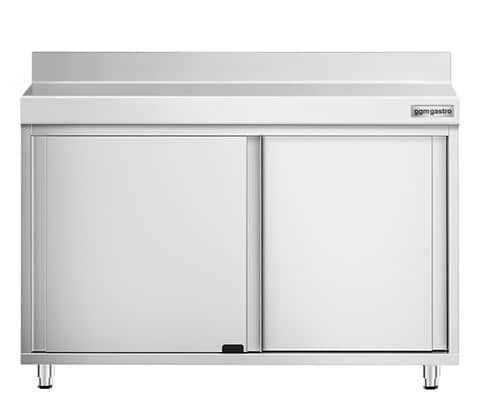
Use refrigerated tables to minimize movement during food preparation
Refrigerated counters can directly connect refrigerated storage and work surfaces. This is particularly important in situations where prepared poultry portions or other refrigerated ingredients must be readily available during a production phase. Larger stock quantities can continue to be stored in a separate cold storage area. In contrast, only the necessary working stock is kept directly at the production line. This separation reduces walking distances and prevents employees from having to leave the actual production area during each new batch. The sizing should also match the work rhythm. A very large workstation refrigeration unit takes up valuable space, while a solution that is too small must be constantly restocked. The key factor, therefore, is the amount actually needed between two scheduled restocking cycles.
Organize marinating as a predictable step in the preparation process
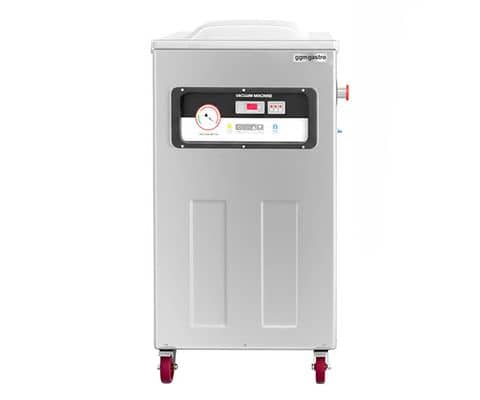
For many chicken dishes, the flavor and product concept are already determined before the actual cooking process begins. Marinating or seasoning should therefore not be treated as an improvised step taken immediately before the chicken goes into the deep fryer or onto the grill. Vacuum marinating machines can support a recurring marinating process when used in appropriate production workflows. Structured preparation can help organize quantities more effectively, especially for larger or regularly recurring batches. Coordination with the overall production schedule remains crucial. What quantity is needed for the lunch service? Which batch is intended for the evening? Which products go to the fried chicken line afterward, and which go to the grill? Clear batch and container assignments simplify preparation and prevent unnecessary searching and setup processes during peak sales hours.
Quick Checklist for the Right Fried & Grilled Chicken Equipment
Five questions can help narrow down your actual needs:
- Core product line: Is the focus on fried chicken, grilled chicken, or a combination of both?
- Peak volume: How many servings or poultry products need to be produced during the busiest 30 to 60 minutes?
- Product mix: Do you offer whole chickens, individual chicken parts, wings, fillets, or a variety of options?
- Service format: Does restaurant service, takeout, delivery, or quick counter service dominate?
- Preparation: What quantities are marinated, breaded, and chilled in preparation for service?
These factors determine which station is likely to become the main bottleneck and where additional capacity will provide the greatest operational benefit.
Design the breading station as a separate production zone
When it comes to fried chicken, preparing the breading is key to maintaining a smooth workflow. A breading station creates a clearly defined area between the refrigerated prep station and the deep fryer. There, the necessary steps can be carried out in an organized manner without constantly cluttering other prep surfaces with breadcrumbs, spice mixes, or containers. A clear sequence is especially important when handling larger quantities. Poultry is transferred from the prepared or marinated stock to the breading station, processed there, and then immediately passed on to the deep-frying station. Conversely, excessive intermediate quantities can block work surfaces. Therefore, the breading capacity should match the frying capacity. If breading is significantly faster than frying, a backlog forms in front of the fryer. If the breading station is too slow, the high-performance fryer will be waiting for more food.
Aligning breading throughput and frying capacity
Fried chicken is a good example of why individual pieces of equipment shouldn’t be sized in isolation. A high-performance deep fryer can only achieve high throughput if prepared food is available continuously. Conversely, a large breading station is of little use if only small batches can be cooked. When planning, it’s therefore worth doing a simple volume calculation: How many servings can the breading station prepare within a given time frame, and how many of those can the deep fryer handle immediately afterward? Cooking time also affects this rhythm. The ideal kitchen layout is achieved when preparation, breading, cooking, and serving can each handle approximately the same peak load. This prevents the bottleneck from simply shifting from one workstation to the next.
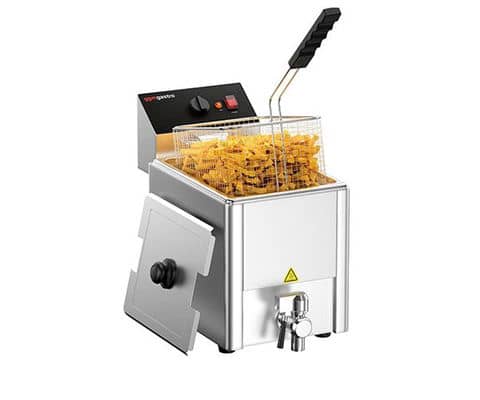
Select deep fryers by chicken variety and batch size
Deep fryers serve as the central cooking station for many fried chicken concepts. Factors such as cooking capacity, product size, required batch sizes, and the number of fried items offered simultaneously all play a role in the selection process. Chicken wings, for example, have different requirements for portioning and utilization than larger cuts of poultry. If french fries or other fried side dishes are also offered, several high-revenue products may compete for the same capacity. This should be taken into account as early as the kitchen planning stage. A deep fryer can theoretically have sufficient total capacity and still become a bottleneck during peak times if different product groups must be produced continuously one after another. Separate capacities can be useful where different products generate high demand simultaneously.
Plan for high-pressure fryers for specialized fried chicken processes
High-pressure fryers constitute a highly specialized category of equipment within this business sector. Your selection should be directly tied to your own fried chicken concept and planned production volumes. Here, too, theoretical equipment capacity is not the only decisive factor. Preparation, breading, batch size, and subsequent serving must align with the capacity. A high-performance cooking station only provides a real advantage if the rest of the kitchen can keep up with that pace. This also includes sufficient workspace before and after the equipment. Prepared items must be able to reach the fryer in an orderly manner. Finished batches then need a clear path to the draining station, warming station, portioning station, or serving station. The higher the production output, the more important these transfer areas become.
Treat Frying Oil as a Separate Operational Process
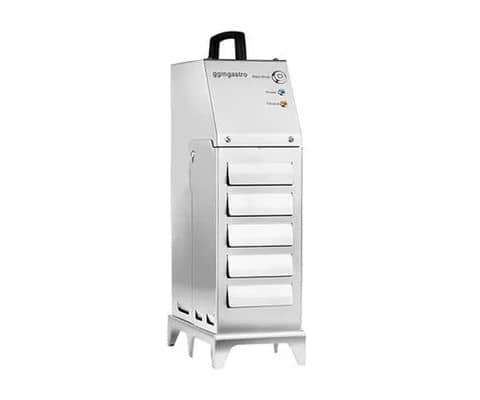
In a chicken concept that relies heavily on deep-frying, it’s not just the deep fryer itself that’s important for operations. How frying oil is handled also affects daily workflows. Deep-frying oil filters can be part of a structured oil maintenance program. It is crucial not to add cleaning and handling steps as an afterthought to an already fully occupied cooking line. Sufficient space is needed for the planned work steps, along with a safe and clear workflow around the equipment. Replacement and cleaning times should also be factored into operational planning. If the entire frying station is shut down for maintenance at an inopportune time, this can directly impact sales in a concept heavily focused on fried chicken. Maintenance and cleaning are therefore scheduled during predictable operational windows whenever possible.
Sizing chicken grills as a separate production line
With grilled chicken, the main bottleneck shifts from the deep fryer to the grill. Chicken grills allow for the simultaneous production of multiple poultry products, depending on the model and capacity. A key factor in selecting the right equipment is how many finished products are needed within a sales window. Unlike very short à la carte processes, planning here often needs to be done further in advance. Production of a whole chicken cannot begin only after the customer has placed an order. The business therefore relies more heavily on sales forecasts and production batches. How many chickens are needed for the lunch rush? When does the next batch need to start? How much do sales fluctuate between weekdays or times of day? The required grilling capacity is determined by answering these questions.
Produce Grilled Chicken According to the Sales Schedule
The challenge with a barbecue concept is to align production as closely as possible with actual sales. Batches that are too small can lead to a shortage of food during peak hours. Conversely, production volumes that are too large can result in unnecessarily long holding times. Production planning should therefore be based on empirical data and typical customer traffic patterns. For example, a location with heavy lunchtime business can schedule an appropriate batch before the start of this time window and then produce additional portions based on actual consumption. Seasonal or weekday-specific variations can also be relevant. An efficient chicken station therefore does not operate exclusively at maximum equipment capacity, but rather follows a coordinated sequence of grilling, holding, and replenishing.
Organizing Fried and Grilled Chicken Effectively in Parallel
If a restaurant offers both product groups, this results in two different cooking processes. The common ground lies in storage, refrigerated preparation, seasoning or marinating, and, if necessary, portioning. After that, the processes should diverge. Fried chicken proceeds from the breading station to the deep fryer and then to the serving area. Grilled chicken moves from preparation or marinating to the grill. After cooking, both product lines can converge again in a shared area for holding, portioning, packaging, and handoff. This Y-shaped production structure prevents employees from constantly switching between completely different workflows. At the same time, shared resources can be utilized where they actually make sense.
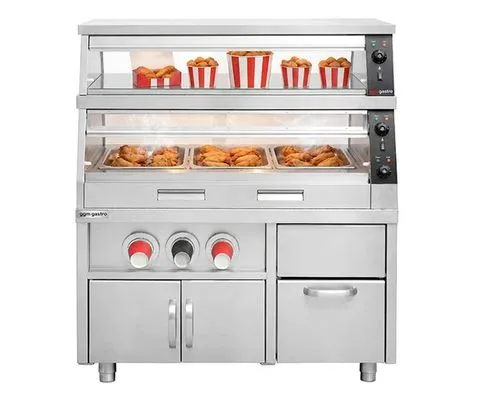
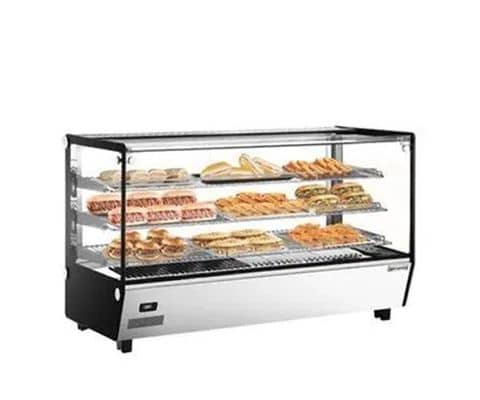
Use heated display cases between production and sales
With chicken concepts, demand can fluctuate significantly within a short period of time. Warming display cases can serve as a controlled buffer between production and quick service. This ensures that suitable products are immediately available at the sales area without having to be produced from scratch for every order. However, the amount kept warm should match the sales frequency. A large display case does not automatically mean you should preproduce large quantities. The key factor is how quickly the merchandise is actually sold and replaced with freshly produced batches. Especially with high sales frequency, a smaller display that is continuously restocked can be more practical than a very large quantity that sits on the shelf for long periods. Production planning and warming capacity are therefore closely interlinked.
Use the heat bridge for direct output
In addition to extended holding times, there may be a short-term transfer point in the production area between the fryer or grill and the serving station. Depending on the layout, heat bridges, lamps, or warming plates can support this area. The focus here is less on large stock reserves and more on synchronizing individual orders. The chicken is ready, while, for example, the side dish, sauce, or packaging is still being prepared. A clearly defined handoff area prevents finished products from being set down on random work surfaces. This also makes it easier to track orders. Orders for dine-in, takeout, and delivery should remain traceable during peak hours and not get mixed up with other production batches.
Don't Let French Fries and Side Dishes Become a Hidden Bottleneck
In a chicken-based concept, the focus is on the chicken, but orders often include more than one item. French fries, salads, sauces, and other sides must be available at the same pace. French fries, in particular, can place an additional heavy load on a frying station. When chicken and sides share the same capacity, two key components of the same order end up competing with each other. The total wait time is then determined by the slower process. Cold sides also require their own preparation. Salad stations and prep tables, for example, can be useful in areas where salads, toppings, or other chilled components are regularly needed immediately before serving. The side station should therefore be planned as part of the overall production process—not as an afterthought.
Organize sauces and toppings right at the finishing station
Sauces are an integral part of the product identity for many fried-and-grilled chicken concepts. However, offering different varieties requires additional steps. Squeeze bottles, dispensers, and other tools should therefore be readily available at a clearly defined finishing or packaging station. Frequently used sauces should be within easy reach, while less common varieties can be organized behind them. A clear ordering system is especially important for takeout and delivery. A missing sauce or an incorrectly assembled side dish results in rework, even though the chicken itself was prepared correctly. A well-organized finishing station therefore supports both speed and order accuracy in equal measure.
Decouple beverage cooling from the production area
Many chicken restaurant concepts generate a significant portion of their sales through meal deals that include beverages. Beverage refrigerators can provide chilled bottles and cans directly in the sales or serving area. However, the beverage station should, if possible, not intersect with the paths used for hot food preparation. Employees or guests retrieving beverages should not have to constantly walk past the deep fryer, grill, or packaging station. In a self-service setting, for example, the beverage cooler can be integrated into the customer flow. In a staffed service setting, frequently sold beverages should be quickly accessible to staff. This ensures that the hot production zone remains focused on its actual task.
Plan for takeout and delivery as an integral part of the production line
Fried & Grilled Chicken is particularly well-suited for concepts with a high proportion of takeout orders. This makes the packaging station a central workstation. To-Go Boxes, bags, napkins, sauce containers, and other packaging materials should be readily available right where orders are being assembled. The task isn’t simply “packing up the chicken.” The main item, side dish, sauce, beverage, and any other items must be carefully matched to the correct order. With a high volume of delivery orders, it may therefore be worthwhile to set up a separate pickup area for drivers or customers picking up their orders. This way, waiting orders do not block either the counter or the traditional restaurant service.
Separate checkout, production, and pickup
In a busy quick-service restaurant, there are often three distinct flows of people: guests placing orders and paying, others waiting for their orders, and additional customers or drivers picking up ready-to-go items. When all these processes take place at a single location, unnecessary lines can quickly form. Space planning should therefore clarify: Where are orders placed? Where is payment made? Where do guests wait? Where are the finished meals handed over? The point-of-sale system and pickup area must be scaled to match production capacity. Adding more ordering terminals is of little use if the kitchen has limited throughput. At the same time, a high-performance chicken line should not be slowed down by orders and payments being processed too slowly.
Clearly assign work orders and production orders to workstations
Restaurants that serve fried and grilled chicken along with various side dishes may have multiple production stations operating simultaneously. Order terminals or digital ordering systems should therefore allow for clear assignment of orders. The frying station must be able to identify which fried chicken products are needed. The grilling area operates according to its production schedule. The finishing and packaging stations must then know which components belong to which order. The higher the volume, the less this process should rely on verbal calls and personal memory. A clear order logic also facilitates the coordination of multiple employees during peak hours.
Plan for Exhaust Air and Technical Infrastructure Early On
Deep fryers and chicken grills are among the most heavily used heat sources in a chicken restaurant concept. It is therefore crucial to incorporate ventilation and technical requirements into the kitchen planning at an early stage. The electrical and gas supplies, connected load, and floor space must also be compatible with the chosen combination of equipment. For example, several high-capacity deep fryers may require a completely different technical setup than a small snack station. The same applies to grilling equipment. Equipment selection and infrastructure should therefore be planned together. Otherwise, retroactive adjustments can unnecessarily complicate the setup of what is otherwise a well-designed production line.
Incorporate grease removal and cleaning as an integral part of daily operations
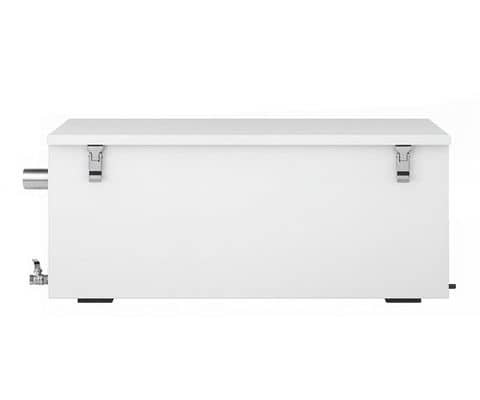
Deep-frying and grilling place high demands on daily cleaning. Grease, breading residue, and other production byproducts accumulate regularly and require specific cleaning processes. Depending on the operation and infrastructure, grease traps may be another component of the technical planning. The accessibility of the equipment is also important. A very densely packed production line may appear to make optimal use of the space at first glance, but it can significantly complicate daily cleaning and maintenance. There must be sufficient space between and around equipment to reach the relevant surfaces. The breading station and preparation area should also be designed so that residues can be removed in a controlled manner during operation.
Organize cooking utensils for raw and cooked chicken clearly
Pliers, scissors, containers, and other work equipment are needed in several production steps. They should be clearly assigned to their respective stations. Tools used in the preparation of raw poultry should not be left unchecked in the area for fully cooked products. Similarly, the grill requires different work equipment than the breading or deep-frying station. Dedicated storage locations facilitate this separation and reduce search times. Especially during peak hours, it is problematic when employees constantly have to move the same tongs or scissors between different stations. Having a sufficient supply of clearly organized work equipment therefore supports both workflow and a structured kitchen organization.
Size the fried-and-grilled chicken equipment to accommodate post-peak demand
Chicken concepts can reach very high volume figures in a short period of time. Lunch, dinner, and delivery peak times, in particular, often put a strain on multiple stations simultaneously. Capacity planning should therefore not be based on the daily average. For example, it is crucial to determine how many portions of fried chicken and how many grilled chicken portions are needed during the busiest hour. Then, work backward: How many batches must the fryer or grill produce? How quickly must the breading station replenish supplies? What cooling capacity is required? How large does the holding area need to be? How many orders can the packaging station complete at the same time? This creates a production chain in which the individual sections are coordinated to handle the same workload.
Check the menu for production speed
A focused menu is often a key factor in productivity for chicken concepts. More variations do not automatically mean more cooking techniques if the same basic ingredients are combined in a thoughtful way. For example, a chicken product can be varied through different sauces, levels of spiciness, sides, or portion sizes without each offering requiring its own production process. It becomes more complicated when each additional item requires new cooking methods or separate ingredients. The menu should therefore be reviewed to determine how many different processes it actually generates in the kitchen. Especially in the quick-service sector, a menu is efficient when the options feel diverse to the guest, but the production behind them is based on just a few clear processes.
Fried or Grilled: Prioritizing Investments Based on the Core Product
Not every chicken restaurant needs the same equipment. For a dedicated fried chicken concept, refrigerated prep areas, breading stations, frying capacity, oil management, and holding systems are top priorities. For a grilled chicken restaurant, the investment shifts more toward marinating, grilling capacity, and production planning for whole or larger cuts of poultry. A mixed concept requires both lines—but should still define which product group drives the majority of revenue. This prioritization prevents the budget from being spread evenly across many pieces of equipment, even though certain stations are significantly more important to the business’s success.
Modernize the Existing Chicken Kitchen to Overcome the Bottleneck
When modernizing, the largest or oldest piece of equipment isn’t automatically the best place to start. Long wait times can result, for example, from insufficient frying capacity. Other possible causes include a breading station that’s too slow, a lack of prepped ingredients, a holding area that’s too small, or an overloaded packaging zone. With grilled chicken, on the other hand, batch planning—rather than the size of the grill itself—may be the real problem. That’s why it’s worth observing the peak sales period. Where does product pile up? Where are staff waiting? Which station is constantly operating at capacity? And where is the finished product sitting because the next process isn’t ready yet? That’s usually exactly where the investment with the greatest operational impact lies.
Professional Equipment for Fried & Grilled Chicken with GGM Gastro
From specialized fried chicken shops to chicken grill restaurants and take-out concepts, all the way to establishments offering both fried and grilled chicken under one roof, production processes and capacity requirements vary significantly. The right equipment is therefore determined by the product mix, batch size, peak demand, sales format, and the organization of preparation and service. GGM Gastro offers professional commercial equipment for this purpose, ranging from deep fryers, high-pressure fryers, and breading stations to chicken grills, refrigerated counters, and vacuum-marinating technology, as well as holding cases, oil filtration systems, to-go equipment, and other chicken and snack bar accessories. This allows for the configuration of both complete production lines for a new location and targeted expansions of existing fried and grilled chicken concepts.