


Asian Restaurant: Equipment for Professional Kitchens
From high-performance wok techniques to rice and noodle preparation, steaming, deep-frying, and chilled presentation: The equipment in an Asian restaurant must combine various cooking methods in a compact space to ensure efficient workflows. Which appliances are suitable depends primarily on the kitchen style, menu, order volume, production methods, and available space. Asian Restaurant Guide »
especially for Asian cuisine






Accessories







Designing an Asian Restaurant: From Kitchen Concept to Furnishings
Professional equipment for an Asian restaurant includes specialized cooking equipment as well as refrigeration, preparation, and serving areas for typical food production processes such as wok cooking, rice and noodle preparation, steaming, deep-frying, or the refrigerated display of appropriate dishes. However, there is no single type of Asian restaurant kitchen. A wok-based concept with a strong takeout business requires different priorities than a sushi restaurant, an establishment serving curries and tandoori dishes, or a restaurant with an extensive buffet. Vietnamese, Chinese, Japanese, Thai, and other cuisines can also have completely different core processes. The selection of equipment therefore begins with the menu: Which cooking methods are used most frequently? Which ingredients must be readily available right at the cooking station? Which components can be prepared in advance? And which orders arrive simultaneously during peak service times? Only by addressing these questions can a kitchen layout be designed that fits the actual concept.
Organizing a Wok Station as a High-Performance Workstation
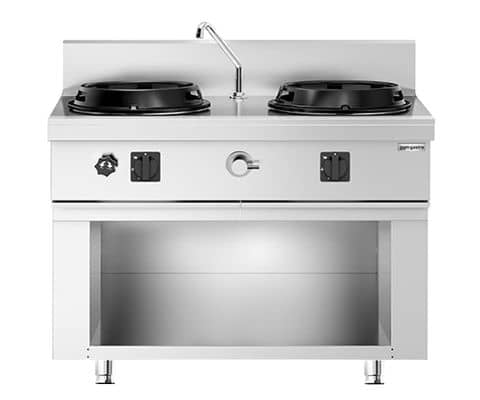
In many Asian kitchens, the wok is a central cooking tool. Wok stoves are designed for workflows in which ingredients are prepared quickly and passed on immediately. This is precisely why organization around the stove plays such a crucial role. Chopped vegetables, meat, fish, sauces, oils, and other prepared ingredients must be readily available. Woks, ladles, and containers should also be kept right at the station. During the preparation of an order, the chef should have to switch between the wok, the refrigerator, and the prep area as little as possible. This is because the actual cooking time can be very short—long search times and walking distances beforehand negate this speed advantage. A high-performance wok station, therefore, consists of more than just the stove. It combines cooking technology, mise en place, production-near refrigeration, workspace, and serving into a compact workstation.
Mise en place determines the pace in the wok
With a fast-paced cooking style, a large part of the work shifts to the preparation phase. Vegetables must be cut, proteins portioned, sauces prepared, and other ingredients set out in appropriate quantities before the first peak order period begins. Salad stations & prep tables can combine workspace with production-near refrigeration. This ensures that frequently used ingredients remain readily available right at the respective station. This is particularly important when many dishes are based on a common foundation. For example, different wok dishes may use various combinations of the same vegetables, proteins, noodles, or sauces. A clearly structured mise en place station makes it possible to assemble these variations quickly. Conversely, the more extensive the menu and the greater the number of different ingredients, the more refrigeration, storage containers, and counter space are required.
Quick Checklist for Choosing the Right Equipment for an Asian Restaurant
Here are five points to help narrow down your needs:
- Cuisine: Is the focus on wok dishes, sushi, noodle dishes, curries, dumplings, tandoori, or a mixed menu?
- Peak Volume: How many dishes need to be produced simultaneously during the busiest 30- to 60-minute period?
- Cooking Methods: Which techniques are actually used for the majority of orders?
- Mise en Place: Which ingredients must be refrigerated and readily available at the production stations?
- Service format: Does restaurant service, buffet, takeout, delivery, or a combination of these dominate?
These criteria reveal which equipment forms the core of the kitchen and at which stations additional capacity provides the greatest operational benefit.
Sizing Rice Cookers Based on Usage and Maintenance Frequency
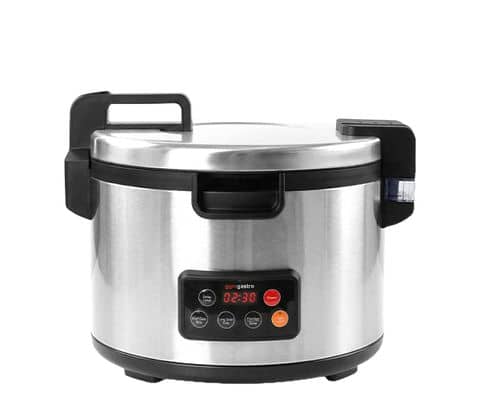
Rice is one of the staple ingredients regularly used in many Asian restaurant concepts. Rice cookers enable a clearly defined production station that can be separated from the actual wok or cooking line. When determining the appropriate size, the daily volume alone is not the deciding factor. What matters is how much rice is needed within a specific time frame, what batch sizes are produced, and how quickly new batches can be prepared between individual cooking cycles. A restaurant with heavy lunchtime traffic may need a larger quantity even before the peak begins. An establishment with longer service hours, on the other hand, can operate more effectively in multiple batches. Placement is also important. The cooked rice should be available as close as possible to the portioning and serving areas without blocking the workspace in the hot kitchen.
Coordinating Rice Production and Heat Retention
Rice production doesn’t end with the cooking process. Between completion and serving, the required quantity must be integrated into the service in a practical way. Producing very large batches results in less post-production work, but may also mean a longer holding time. Conversely, batches that are too small can result in the need to constantly produce new batches during peak order times. The appropriate quantity is therefore based on the actual sales rhythm. Rice portioners, containers, and the transfer to wok, curry, or serving stations are also part of the planning process. A standardized portioning process can be particularly helpful—especially with high order frequency—in organizing serving in a consistent manner and better estimating consumption.
Consider the pasta cooker as a separate production station
Pasta cookers can play a key role in establishments where pasta dishes regularly make up a large portion of the menu. Depending on the concept, noodles may be cooked to order, pre-cooked, or further processed in subsequent production steps. The station must therefore be suited to the desired production method. In addition to the appliance’s performance, factors such as water, draining areas, portioning, and transfer to the wok or serving station play a role. Especially when multiple noodle dishes are ordered simultaneously, the number of portions that can be processed at once becomes critical. If the wok station operates faster than the noodle station can supply it, the bottleneck immediately shifts to this upstream production stage. Wok and noodle capacities should therefore be coordinated with one another.
Plan to steam dumplings and other dishes
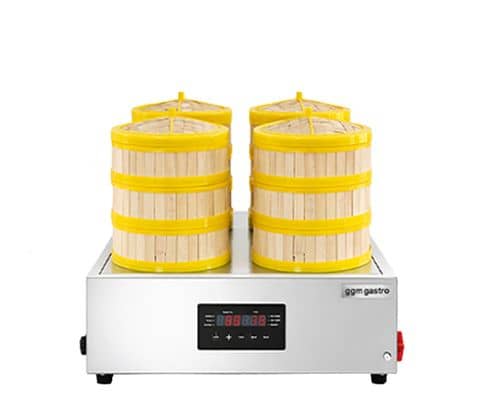
Steamed products introduce another distinct cooking method to the kitchen. Dumpling cookers, for example, can serve as a clearly defined production station for such dishes. Depending on the concept, other steaming methods may also be used. The key factor is the quantity required simultaneously during a service period. For appetizers or side dishes, sales can fluctuate significantly with the main business. In concepts where dumplings or similar products are part of the core menu, however, the corresponding cooking station becomes a key capacity factor. Restocking and removal must also be factored into the workflow. Prepared products require suitable storage nearby, while finished dishes should reach the serving area without unnecessary detours.
Planning Fryers Based on Product Mix and Peak Load
Deep fryers are part of the production mix in many Asian restaurant kitchens. Depending on the menu, they can be used to prepare certain appetizers, side dishes, or other fried items, for example. When planning capacity, the most important factor is which popular items are using the same deep fryer at the same time. If several high-demand dishes require the same cooking station, even a high-performance kitchen can come to a standstill at that single point. It’s not just the total volume that should be considered. Different products may also require organizationally separate processes. Baskets, work surfaces, preparation areas, and holding stations must therefore be suited to the menu. A larger deep fryer alone will not resolve a bottleneck if portioning or serving before or after it is organized too slowly.
Organize tandoori and oven-baked dishes as separate menu categories
Restaurants serving Indian cuisine or similar dishes may require additional cooking methods. Poultry or tandoori ovens involve a different production process than woks, deep fryers, or pasta cookers. If such dishes are offered regularly, preparation, marinating, refrigerated storage, and the subsequent cooking station require a well-defined workflow. The station does not necessarily have to be located directly next to the wok area. A layout based on the restaurant’s own ingredient and production flow makes more sense. Frequently used ingredients remain close to their respective cooking stations, while the various dishes are then brought together at the pass or serving station. This allows different Asian culinary styles to coexist within a single restaurant without all stations having to share the same workspace.
Use combi ovens for predictable batches and food preparation
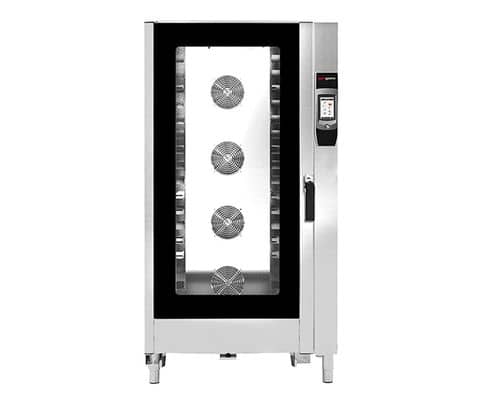
Combi-steamers can create additional production capabilities in suitable restaurant concepts. They are particularly well-suited for settings where specific components are prepared, cooked, or set aside for further production steps in predictable batches. The key factor is which tasks the appliance actually performs within the establishment’s menu. A combi-steamer should not be planned for merely as an additional piece of general-purpose equipment. Its operational value arises when recurring processes are consolidated, thereby relieving the workload on other heavily utilized stations. Its capacity and location must also fit in with the rest of the kitchen. Baking sheets and GN containers require preparation and storage space. After the cooking process, products must also be able to be transferred to refrigeration, holding, or further processing without having to travel long distances.
Keep sushi preparation clearly separate from the hot kitchen
In restaurants that serve sushi, a production area that is significantly different from the hot kitchen is created. Here, the focus is on preparation, portioning, clean work surfaces, and chilled ingredients. Fish, vegetables, and other ingredients are prepared and then processed directly at the sushi station. This area should therefore be disrupted as little as possible by foot traffic from the wok, deep-fry, or dishwashing stations. Sushi display cases can keep suitable ingredients or products chilled while also keeping them clearly visible at the workstation or in the display area. The required size depends on the actual product range. Too much display capacity takes up counter space, while a solution that’s too small may require frequent restocking.
Understanding Sushi Refrigeration as Part of the Workplace
When it comes to sushi, refrigeration isn’t just about storage in the background. The production area itself requires a controlled inventory so that ingredients remain readily available during service with as little movement as possible. Larger reserves can be refrigerated separately. This separation between the main storage area and workstation refrigeration prevents the need to constantly access larger refrigerators or cold rooms for individual portions. At the same time, the quantity at the workstation should remain aligned with current production needs. A well-organized sushi area combines preparation, refrigerated storage, portioning, and serving within a relatively short distance.
Planning Hotpot Concepts Based on Table and Serving Logic
Hot pot changes the traditional logic of the kitchen because part of the preparation—or rather, the cooking process—is moved closer to the guest. Bain-Maries & Hot Pots can perform the necessary functions depending on the restaurant’s concept. However, this does not eliminate the demands placed on the kitchen. Ingredients must be prepared, portioned, and, if necessary, kept chilled and ready for use. Broths and stock bases require their own production and replenishment procedures. With an extensive hot pot menu, the need for mise en place and organized storage of chilled ingredients increases significantly. Dishware and return traffic may also increase, as numerous individual bowls, plates, or containers are in circulation. The concept should therefore be planned from the outset in conjunction with dishwashing equipment and service routes.
Focus buffet service on restocking rather than filling containers to capacity
Asian restaurants with buffets have different production and service requirements than restaurants that offer only à la carte dining. Buffet counters & salad bars allow for the presentation of various dishes or cold items, depending on the concept. However, it’s not just the number of dishes offered that matters. Each additional item requires preparation, containers, restocking, and ongoing monitoring. A very large buffet can therefore place high demands on the kitchen and staff. Instead of preparing all quantities at the start, structured restocking in smaller batches can be a sensible approach. The kitchen then produces additional portions based on actual consumption and keeps reserves on hand for dishes in particularly high demand. In this way, the buffet and the kitchen are planned as a single integrated system.
Synchronize the wok, rice, and serving to the same rhythm
In an Asian restaurant, individual cooking processes can vary greatly in speed. A wok dish may be ready quickly, while the rice must already be prepared. Noodle dishes require their own lead time, and fried items, in turn, have a different cooking time. At the serving station, however, these components must come together to form the correct order. This is precisely why it’s not enough to optimize each station separately. If one station consistently produces faster than the others, it leads to wait times or finished components having to sit around for an unnecessarily long time. Capacity should therefore be based on the entire order: How quickly can a typical dish be produced from the time the order is placed until it is fully served? The slowest step that is regularly required often determines the actual throughput.
Organize takeout and delivery as a separate distribution channel
Many Asian restaurant concepts combine dine-in service with takeout or delivery. This creates a second serving process in addition to the traditional one. Dishes must be packaged, supplemented as needed with rice, sauces, cutlery, or other components, and then clearly assigned to a specific order. To-Go Boxes and other packaging materials should therefore be located as close as possible to the corresponding pickup station. If restaurant plates and delivery orders are prepared in the same small space, the two channels can interfere with each other during peak hours. If the takeout volume is significant, it is therefore worthwhile to designate a specific packaging zone. Ready-to-serve dishes are brought there from the various cooking stations, fully assembled, and then handed over separately.
Compare the complexity of the menu with the kitchen's performance
Asian menus can become quite extensive. However, many dishes differ only in terms of protein, sauce, vegetables, or side dishes. This can be advantageous from an operational standpoint if the same prepared ingredients are used across multiple dishes. It becomes problematic when additional dishes constantly require new raw ingredients and specific cooking methods. Each new product group can entail additional refrigeration space, containers, preparation, and specialized equipment. An efficient menu therefore makes smart use of shared production components. Wok dishes, for example, can be based on a structured selection of prepared ingredients without requiring a completely separate workstation for each variation. This reduces inventory complexity and facilitates a consistent mise en place.
Organize the cooling process by preparation and production stations
Asian restaurant kitchens often work with numerous pre-prepared individual components. Vegetables, meat, fish, sauces, and other ingredients must be organized until they are used and stored appropriately depending on the product. The large storage refrigeration unit handles the inventory. Refrigerated tables and prep stations located near the production area supply the individual workstations with their current working stock. This layout shortens walking distances and makes restocking easier. The placement of ingredients within each station should also reflect their usage. Products needed for a large portion of orders should be placed in the most easily accessible locations. Rarely used ingredients do not need to occupy the same valuable reach zone.
Plan for exhaust air and technical infrastructure early on
Wok stoves, deep fryers, ovens, and other heavily used cooking appliances place specific demands on the kitchen area. Ventilation and technical infrastructure should therefore be incorporated into the planning of the cooking line at an early stage. It’s not just the individual appliance placement that matters. The combination of multiple heat sources also affects the workspace. In addition, electricity, gas, water, and wastewater connections must be provided according to the selected equipment. A high-performance fleet of appliances can only be used effectively if the technical infrastructure supports that performance. Especially when modernizing existing kitchens, it is therefore important to first assess what conditions are present at the intended location and what adjustments may be necessary.
Tailor dishwashing technology to a wide variety of small kitchen utensils
In addition to plates and glasses, an Asian kitchen generates numerous other items that need to be washed. Woks, pots, GN containers, bowls, knives, cutting boards, and other kitchen tools must be returned to the production cycle on a regular basis. Dishwashers and the entire dishwashing area should therefore be sized to accommodate the actual volume of returnware. It is important to maintain a clear separation between the dirty receiving area and the clean staging area. Large or bulky cooking utensils also require sufficient space. If used containers are collected on prep surfaces during peak hours, the kitchen loses capacity precisely where it is needed for new orders. An organized return process therefore immediately relieves pressure on production.
Integrate cleaning at high cycle rates into the service
Wok cooking, deep-frying, sauces, and intensive prep put a heavy strain on work surfaces and equipment during a service shift. That’s why cleaning must be effective not just at the end of the day. It should be possible to return utensils and containers to their proper places while operations are still underway. Soiled surfaces must remain accessible without having to dismantle entire production stations. Grease and sauce residues, in particular, can increase the cleaning effort. Equipment that is easy to access and maintain therefore reduces the amount of time spent on daily tasks. Sufficient free space between or next to the appliances also facilitates cleaning and prevents hard-to-reach crevices.
Sizing an Asian Restaurant for After-Peak Hours
Many Asian restaurant concepts experience a sharp spike in volume during lunch or dinner service. With takeout and delivery models, a very large number of orders can also come in almost simultaneously. The core equipment must be able to handle precisely this workload. However, the largest wok stove isn’t automatically the most important investment. Perhaps the woks are fast enough, but the noodle cooker is too small. Perhaps there isn’t enough rice, or the mise en place needs to be constantly replenished during peak hours. Capacity planning therefore always considers the entire chain. The wok, rice cooker, noodle cooker, deep fryer, prep station, and packaging station must collectively have sufficient capacity to ensure that the backlog isn’t simply shifted from one station to the next.
Prioritizing equipment for an Asian restaurant based on cost-effectiveness
The most important investments are based on the core menu. A restaurant that focuses heavily on wok dishes accordingly relies on wok technology, mise en place, and production-oriented refrigeration. A sushi concept, on the other hand, prioritizes preparation, appropriate refrigeration, and presentation. In a restaurant with a large proportion of noodles or dumplings, the respective specialized stations become correspondingly more important. Not every Asian restaurant therefore needs every available specialized piece of equipment. Equipment is particularly cost-effective when it supports frequently recurring processes, enables high-volume production, or reduces daily manual bottlenecks. Even when modernizing, it’s worth starting with a process analysis. Long order processing times can result from insufficient cooking capacity—or from a lack of preparation, long distances to refrigeration, insufficient rice production, or an overloaded packaging station. The right investment resolves the actual bottleneck rather than simply adding more equipment to the kitchen.
Professionally Equip Your Asian Restaurant with GGM Gastro
From wok and noodle concepts to sushi and dumplings, and on to tandoori, hot pot, or buffet restaurants, menus and production processes vary considerably. The right equipment for Asian restaurants is therefore based on the cooking methods used regularly, order volume, mise en place, and peak service times. GGM Gastro offers professional kitchen equipment for this purpose, ranging from wok stoves, rice cookers, and noodle cookers to deep fryers, dumpling cookers, and combi-steamers, as well as sushi display cases, hot pot equipment, and preparation tables. This allows for the customization of both specialized kitchen layouts for new openings and individual production areas during modernization, product line expansion, or increases in order volumes, all tailored to specific needs.