


Flour Sifters & Refiners for Commercial Production
Flour sifters aerate larger quantities of flour and remove lumps, while roller refiners process ingredients and pliable mixtures through fine rollers. Both types support consistent, scheduled preparation in bakeries, patisseries and similar production businesses. Find the right machine for your process in our buying guide »
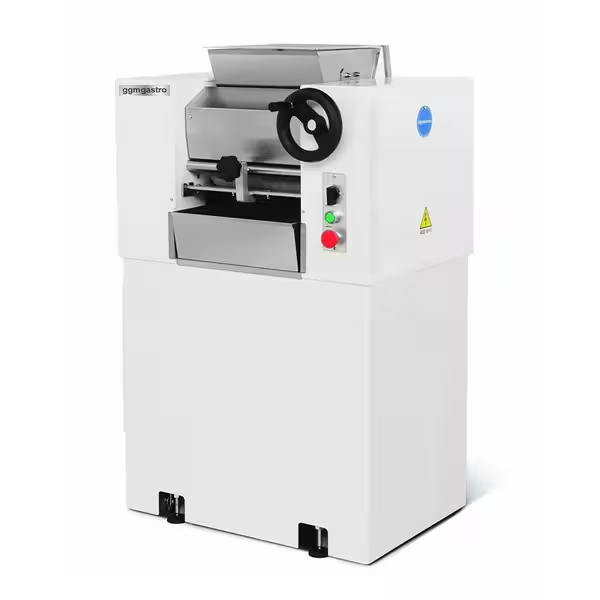
Two machine types for different preparation tasks
Flour sifters and refiners are commercial processing machines for preparing dry ingredients and pliable mixtures. A flour sifter mechanically sieves and aerates flour; a roller refiner reduces or refines ingredients and mixtures between rollers.
The category therefore covers two distinct tasks. In bakeries, pizzerias and larger bakery production facilities, a flour sifter supports consistent flour preparation. It removes lumps before the flour moves to the next processing stage, making repetitive work easier at higher volumes.
Roller refiners are used for products including marzipan, nougat, sugar, nuts and chocolate. Depending on the ingredient and roller gap setting, they produce a finer, more homogeneous mixture. Handheld flour sieves remain more suitable for small quantities; the machines offered here are designed for commercial production.
Match capacity and roller gap to production requirements
For a flour sifter, the main consideration is the quantity of flour prepared during each work period. A 50 kg hopper suits businesses handling whole sacks or larger production batches. The 1 kW motor powers the sifting process, while a wheeled frame allows the machine to be moved as needed.
For a roller refiner, the recipe, initial consistency and required fineness are the key factors. A 2 kg capacity suits smaller, manageable batches. A roller gap adjustable from 0 to 10 mm allows processing to be adapted to different mixtures. Granite and porphyry rollers fulfil a different function from the grinding mechanisms of conventional grain mills: they refine the material through pressure and roller contact.
Plan installation space and power within your workflow
The best position is where ingredients are made ready and then processed. Short distances between storage, sifting or refining and the next dough preparation stage reduce unnecessary movement and keep preparation organised.
Measuring 700 x 1,315 x 1,700 mm, the flour sifter needs a suitably deep installation space. Four castors help position its 150 kg net weight, but room to manoeuvre and a stable standing position are still essential. At 700 x 550 x 1,150 mm, the refiner is more compact but weighs 220 kg. It is also mounted on castors.
Both machines operate on 400 V, 3N~/PE, 50 Hz. A suitable three-phase supply must therefore be available at the intended location before delivery. Allow enough space for loading, operation and cleaning as well.
Stainless steel and cleaning for reliable routines
Smooth stainless steel surfaces support regular cleaning in areas handling flour and sugar. Flour dust, nut particles and sticky mixtures must not be allowed to build up in hard-to-reach places. Cleaning access and accessibility of food-contact areas therefore matter as much as power and capacity.
Pay particular attention to thorough cleaning between recipes. This is also important for allergen control when handling nuts. Before cleaning, adjustment or inspection, shut down the machine safely in accordance with its operating instructions. An accessible position makes routine care easier and reduces the work required at the end of a production run.
Quick check for choosing a flour sifter or refiner
-
Identify the task: sifting flour or refining ingredients and mixtures
-
Compare batch size with the respective 50 kg or 2 kg capacity
-
Consider roller gap and the required final consistency
-
Allow for footprint, machine weight and manoeuvring space
-
Check the 400 V supply and cleaning access in advance
Plan a coherent process from ingredients to further preparation
A correctly sized machine supports repeatable routines, reduces manual work for your team and can limit variations in preparation. It becomes particularly worthwhile when it resolves a recurring bottleneck and fits the existing production volume.
For an organised workstation, combine flour sifters and refiners with accessible stainless steel kitchen furniture and suitable containers for ingredients and processed batches. Keep their roles clear: the sifter prepares flour, while the roller refiner processes suitable ingredients and mixtures. This distinction makes it easier to choose a machine that meets your technical and operational needs.